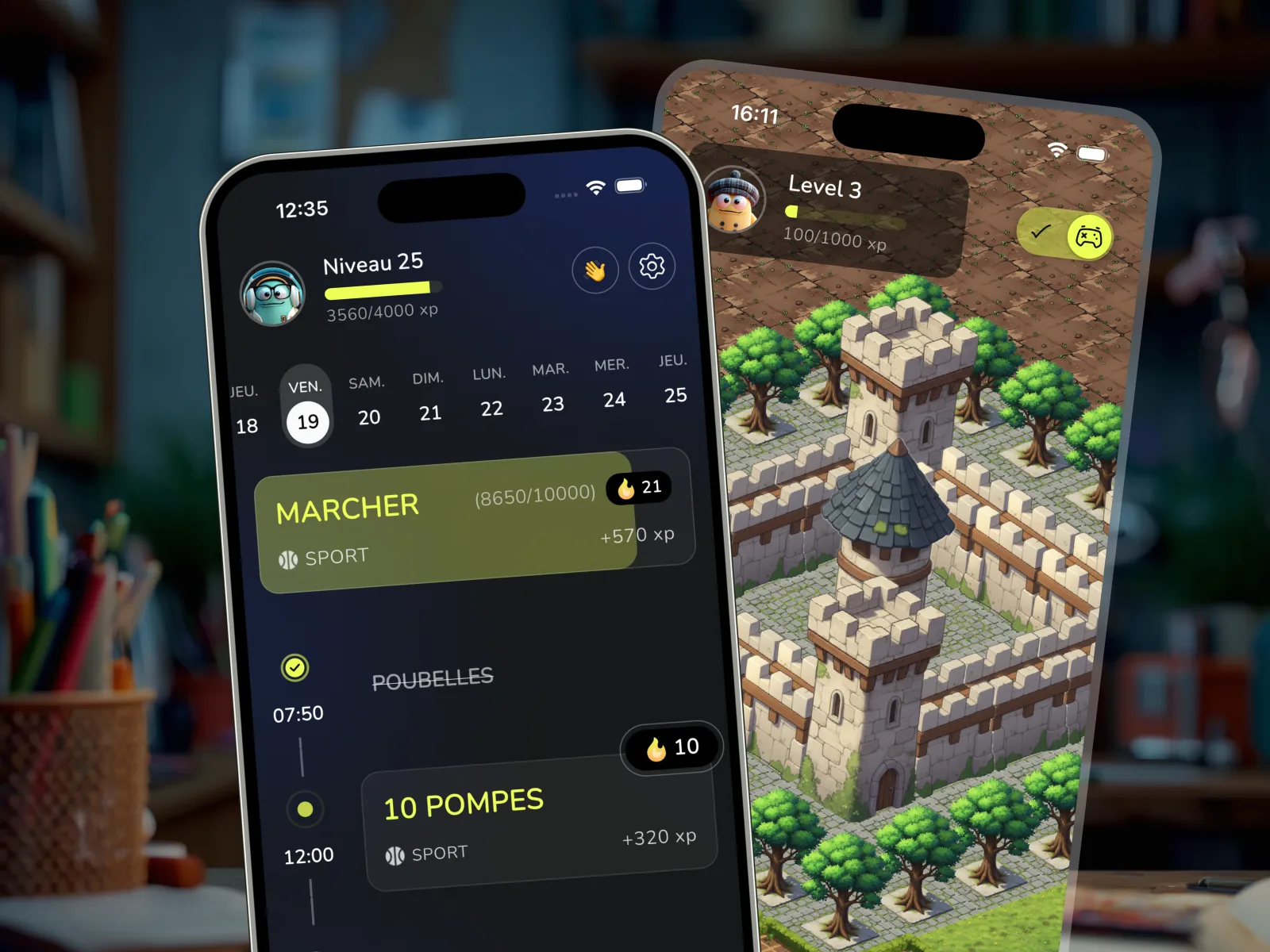
You have tried a points app. It was good for eleven days. Then the points stopped meaning anything and you went back to a list.
That is the normal outcome, and it is not your fault. Most gamification is a scoreboard bolted onto a chore. Scoreboards get old.
Some of it does hold, though, and the difference between the two is not subtle once you know where to look.
What gamification is actually doing
Strip the language away and it does three things:
- It makes progress visible. Habits pay off in months. Your motivation runs on days. Gamification bridges that gap by showing you something today.
- It gives an unclear task a clear shape. “Get fitter” has no edges. “Run three times this week” does. Half the value is just the definition.
- It rewards showing up rather than results. You cannot control whether you lose weight this month. You can control whether you went out. Scoring the action keeps you going through the weeks where results have not arrived.
Note what is not on that list: making work fun. Gamification does not make a boring task interesting. It makes an invisible task visible. Confusing the two is the root of most failed attempts.
Why most of it wears off
The reward has nothing behind it. A number that goes up is a number that goes up. Once you notice it buys nothing and means nothing, it stops working. Points need something to spend them on, or they are decoration.
Streaks turn into a trap. A streak is a strong motivator right up to the day it breaks — then it becomes a reason to quit. You had eighty-four days, you missed one, and now the number that pulled you along is gone. A system built entirely on an unbroken run gives you one way to fail and no way back.
Rewards can crowd out the reason you started. This one is well documented: pay people for something they already enjoy, and their interest often drops once the pay stops. If you already like running, scoring your runs can make them feel like work. Gamification helps most with things you do not yet want to do, and can actively hurt things you already like.
It gets boring on schedule. Any fixed reward loses its pull. Same points, same badge, same green square — after three weeks your brain stops registering it. Novelty is doing more of the work than people think, and novelty runs out.
Some of it is just a chore with stickers. If the app takes two minutes of tapping per habit, the tracking becomes the task. Now you have two things to fail at.
What the ones that last do differently
The reward buys something. Points that convert into a decision — what to build, what to unlock, what to spend on — hold their value far longer than points that only accumulate. The reward is not the number. The number is the currency, and the spending is the reward.
Progress you can see, not just count. “Day 47” is a fact. A city that is visibly larger than it was last month is a picture. Pictures survive a bad week; numbers do not. When you come back after missing four days, a number tells you what you lost. A structure tells you what you still have.
Missing a day is survivable. The good systems make a miss cost something without wiping the slate. A setback you can recover from keeps you in the game. A total reset sends you to a new app. This is the single biggest difference between systems people keep and systems people abandon, and it is worth checking before you commit to anything.
The difficulty moves. Ten press-ups is a challenge in week one and a warm-up in week eight. A system that never changes what it asks stops registering. One that scales — more, harder, longer — keeps the same task interesting for months.
Tracking takes seconds. One tap. If logging the habit is harder than the habit, the tracking dies first, then the habit.
Does it actually work?
The honest answer: it works, unevenly, and the size of the effect depends heavily on the design and on you.
Reviews of gamified health and behaviour apps generally find positive effects on engagement and on the tracked behaviour, with two consistent caveats. Effects are larger in the first weeks than later. And the studies vary so much in what they call “gamification” that pooling them is close to meaningless — a badge and a full progression system are not the same intervention.
What holds up across most of it:
- It helps most with tasks you find dull but want to do anyway
- It helps least with tasks you already enjoy
- Visible progress and social comparison do more work than points alone
- Nothing survives a design that punishes a single missed day
Read a longer treatment in does gamification help build habits, or the comparison with plain trackers in gamified vs traditional habit trackers.
How to judge an app in five minutes
Before you commit a month to something, check five things:
- What do the points buy? If the answer is nothing, the points will stop working around week two.
- What happens when I miss a day? Look for a real cost with a real way back. Avoid anything that resets you to zero.
- How long does logging take? Time it. Over five seconds per habit and you will stop.
- Does it get harder? If the challenge in month three is identical to week one, you will have stopped noticing it by then.
- Do I already enjoy this activity? If yes, consider not gamifying it. You may be about to spoil something that was working.
What this looks like in practice
Take one habit you do not want to do but should. Not three — one.
Define the smallest version that still counts, so you can do it on a bad day. Score the action, not the result. Set up a way to see a month of it at once, because that is the view that keeps you going. And decide now, while you are calm, what you will do the first time you miss two days in a row — because you will, and the plan you make today is better than the one you would make in the moment.
That is the whole thing. Everything else is presentation.
KUBBO is built on that shape: finishing habits pays XP and Gold, and you spend the Gold on a medieval city that grows as you do. Miss two days and a building gets buried — you dig it back out with Gold. You lose something real, and you get it back. That is deliberate, and it is the part most systems get wrong.
More on the mechanics in gamify your life, and the evidence behind the design in the science.