The alarm goes at seven. You turn it off. You lie there for forty minutes, not asleep and not up. At five to eight you move. You scramble for keys and shoes, skip breakfast, and spend the rest of the day catching up.
Then you read that successful people get up at five and meditate.
That advice is for a different brain.

Why mornings are harder with ADHD
A few things are already in the way before you choose anything.
👉 Your body clock runs late. Adults with ADHD report this more than any other sleep problem. In a study of adults with ADHD who had long trouble falling asleep, melatonin arrived about an hour and a half later than in the comparison group (Van Veen et al., 2010). If the clock says seven and your body still thinks it is half past five, the alarm wakes you in the middle of your own night.

👉 Getting up takes longer than most people allow. The grogginess and slow thinking right after you wake usually clears in 15 to 60 minutes. Researchers have measured it two to four hours after waking, and it is worse the less you slept. Short nights are common when your clock runs late and the alarm still goes at seven.
👉 Showering is easy once the water is on. Getting into the bathroom is the part that stalls. Starting is the hard part. Mornings ask for it most. ADHD supplies it least. The first hour after you wake is when it is weakest.
👉 You cannot feel time passing. Reviews of adult ADHD find that judging how long something took is often wrong. Ten minutes on your phone and ten minutes in the shower do not feel the same length.
Trying harder at 7:15 does not fix this. Deciding things the night before does.
The 5am routine will not last past Thursday
Wake at five. Meditate. Journal three pages. Gym. Cold shower. Green juice. Read twenty pages. Plan the day.

That asks you to wake while your clock still says night, then make a lot of decisions in the ninety minutes when you can barely make one. It works for a week and a bit. You miss a morning. By day fourteen it is gone. Same pattern as the other setup mistakes that kill a new habit.
Could you run it on five hours’ sleep, late, with nothing laid out? If no, you have built a good-day routine. Good days do not need a plan.
Do the morning the night before
You finish most of a working ADHD morning before you go to bed. That is the last hour of the day when your judgement is still yours.
Set a bedtime and treat it as the first step of tomorrow. The usual problem is staying up to take back the only hours nobody else owns. A fixed sleep time does more for your mornings than anything you invent after the alarm.
Put out one set of clothes. Choosing at 07:40 costs you ten minutes and you already know it.
Make one pile by the door. Keys, bag, badge, headphones, water. Everything that leaves the house leaves from the same bit of floor.
👉 Pick breakfast now and eat the same thing on weekdays. Decide once.
👉 Write tomorrow’s first task on paper. One task, small enough to start in two minutes. Leave the rest of the list.
👉 Charge the phone across the room so turning the alarm off means standing up.
Six steps for a bad morning
About thirty-five minutes. Almost nothing to decide.
Feet on the floor when the alarm goes. That is the whole first step. The 2-minute rule at the worst moment of the day: shrink the job until saying no is more work than doing it.
Light within a minute. Outside if you can get there. Outdoor light is 10,000 lux and up; indoor light is a few hundred. Open the curtains and put every lamp on if going out is too much. Morning light is what pulls a late clock earlier.
Water, then the breakfast you already chose. Do not open the fridge and think.
Five minutes of movement. A walk, the stairs, a few press-ups. The evidence on exercise and adult ADHD attention is mixed, but five minutes on your feet ends the grogginess faster than sitting does.
One pass at the door pile. You put it there last night, so you do not have to remember it.
Two minutes on the task you wrote down. That is all you promised.
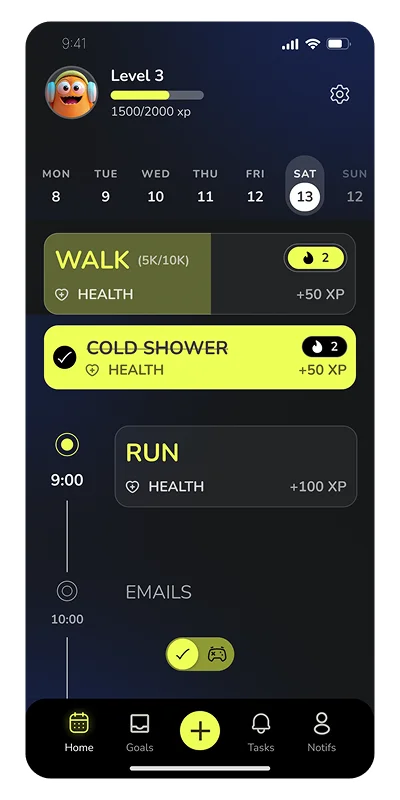
No journaling, no meditation, no gym. Add those later if you want them. They belong in a routine that already runs, not in week one. The fuller habit, if you want it: morning routine.
What is actually doing the work
Light is the strongest cue your body clock takes, and morning is the only time it pulls you earlier. Ten minutes outdoors beats an hour under a ceiling lamp.
Five minutes of movement is enough. You are trying to get off the bed, not train.
Every choice you cut last night is a choice you cannot get wrong at 7:40. Clothes, breakfast, the first task, where the keys are.
You cannot hold the steps in your head right after you wake, so stop trying. Put them where you can see them. A list on the fridge works. So do alarms named after the step (not the clock), or an app that shows the order. A list you can see does most of the job.
When the morning goes wrong
It will. You will oversleep, skip half the steps, and leave with wet hair and no lunch.
One bad morning is one bad morning. The harm is what people do next: they decide the routine is broken and drop it. Habit research points to about two months before you do it without thinking. Missing one day barely moves that. What ends a habit is the story you tell yourself about the miss.
Count days out of ten, not days in a row. Seven mornings out of ten is a routine that works. A broken streak is a number. It tells you nothing useful about tomorrow. Same reason perfect-record systems fail the people who need them.
Pay yourself this morning
The reward of an ADHD morning routine is months away, and your brain values a reward by how soon it arrives. Research on ADHD found the brain’s reward system fires less (Volkow et al., 2009). “This will help in six weeks” is not an argument that works at seven o’clock.
Something has to happen the moment a step is done: a box you can see, points, a number that moves. That is why some kinds of game-like tracking hold.
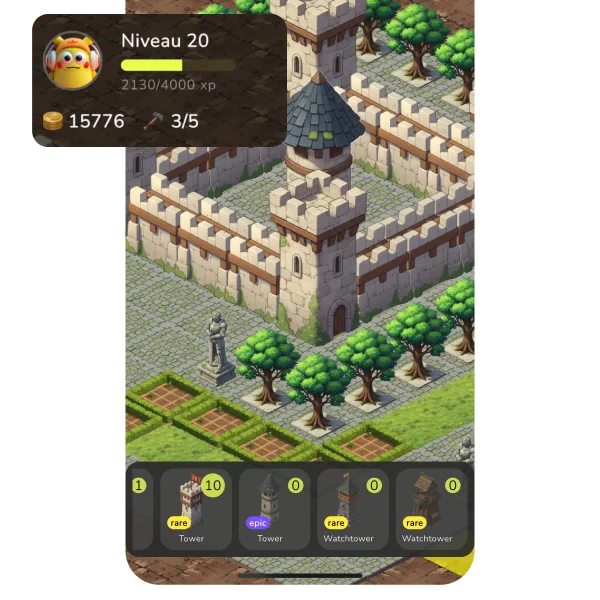
In KUBBO, every step pays out when you tap it. Leave a habit for two days and the game buries a building. You dig it back out with Gold and carry on. No shame screen.
If you want more on this, read how to build habits with ADHD, or see what an ADHD habit tracker does that a checkbox app does not. To compare options first: the best habit trackers for ADHD.
Common questions
What time should you wake up? Later than the internet tells you, and at the same time every day, weekends included. Same time does more than early. If your clock runs late, a 5am start mostly buys you a shorter night and worse grogginess. Waking up early is something to shift toward over weeks, with morning light.
How long should the routine be? Thirty to forty minutes, and keep it under six steps. Long routines fail on the mornings you need them.
Why are you so tired after eight hours? Those eight hours may not have covered the hours your body treats as night, and the grogginess after a badly timed night can last for hours. Fix the timing before you add more effort.
App or paper? Whichever one you will look at. Paper is faster to start with. An app is better once you want reminders, a record of how often you managed it, and something at the end of each step. What KUBBO does with that.
Tomorrow, one thing
Do not build the whole routine tonight. Lay out your clothes, or put one pile by the door.
Run that alone for a week. Add the next piece when the first one costs you nothing.
If the part that always stops you is starting, the procrastination test takes two minutes and tells you where the morning goes.