
You have read the phrase a hundred times. Consistency over motivation. Show up whether you feel like it or not.
True. Useless as advice, though. It names the thing you want and calls it the instruction. Telling someone who cannot stay consistent to be consistent does not tell them how.
The rest of this page: what motivation is, what consistency buys you, and five rules that produce it when you do not feel like anything.
Motivation is a feeling, and feelings move
Motivation is how you feel about doing the thing, at the moment you have to do it. On Sunday evening you feel one way. On Wednesday at 6:40am, tired, with a bad meeting ahead, you feel another. Nothing has gone wrong. Feelings move.
Wanting and doing are only loosely connected. Researchers have run experiments that push people’s intentions up on purpose (health campaigns, persuasion, goal-setting) and then measured what those people did. A medium-to-large rise in intention produced only a small-to-medium rise in behaviour. Researchers have a name for the people behind most of that gap: inclined abstainers. They meant to. They did not.
You have been an inclined abstainer. Everyone has. Extra wanting does not fix it, because extra wanting is the input that already failed.
What consistency buys you
Repeat an action in the same setting and it starts to cost less thinking.
In a diary study, people wore a watch that buzzed every hour and wrote down what they were doing. Around 43% of what they did, they did almost every day, in the same place. They did not decide each time. They just did it.
The prize is cheapness, not virtue. A behaviour you repeat in a stable setting starts to run without asking first. Once it does, your mood on Wednesday stops mattering.
The best evidence comes from a study at University College London. Ninety-six people picked one daily behaviour, did it in the same setting, and rated every day how automatic it felt. The ratings climbed and then flattened. The median time to reach the flat part was 66 days, with a range from 18 to 254 depending on the person and the behaviour. We go through the numbers in how long it takes to build a habit.
One finding should change how you read the phrase at the top of this page. Across six studies of more than two thousand people, researchers checked what people with strong self-control do differently. They resist temptation less, not more. Their good habits are already built, so there is nothing left to resist.
Consistency over motivation is right. Consistency is a way of needing to try less.
Consistency does not mean perfect
This is where most people ruin it. They read “be consistent”, hear “never miss”, miss a Tuesday, and quit on Thursday.
The UCL study checked this directly. Missing one chance to do the behaviour, the authors wrote, did not materially affect the habit formation process. One miss costs you nothing you can measure. What slows the curve is missing again and again.
Now the useful part. In 2021, 30 scientists ran one large experiment on 61,293 gym members: 54 different four-week programmes, all measured the same way. Forty-five per cent of them raised weekly gym visits, by 9% to 27%.
The single best one paid a small reward for coming back after a missed workout.
Not a perfect week. Not a streak. The return. Out of 54 serious attempts by good researchers, the winner was the one that made the day after a miss cheap.
So stop building streaks and start building returns. More on why streaks break people in common mistakes that kill new habits.
Five rules that produce consistency
None of these require you to feel anything.
1. Set the size for your worst day
You choose the target on a good day, so you choose a good-day size. Then Thursday arrives (late, tired, out of patience) and the target is impossible, so you skip.
Pick the number you can hit when everything has gone wrong. Ten minutes, not an hour. One page, not a chapter. You will often do more, and that is fine. The promise has to survive a bad Thursday, because bad Thursdays are the real test. Start at the two-minute size if you have failed at this before.

2. Fix the cue, not the hour
“Read more” tells you nothing about when. So it competes against everything else all day, and loses, every day.
Attach it to something that already happens: after I pour my coffee, I write for ten minutes. An existing habit works better than a time of day. You never forget your coffee. You do ignore an alarm.
This is the most tested trick in the field. A review of 94 separate tests, covering more than 8,000 people, found that writing down when and where you will act has a medium-to-large effect on whether you do it. It takes one sentence: after [thing that already happens], I will [new habit], in [place].
3. Count days, not feelings
Track the action (did you do it, yes or no) and never the result. Results lag by weeks and move for reasons that have nothing to do with you. Track weight or word count and you will quit during a flat month while the habit was working.
Days done is the only number that tells you the truth about the only part you control.
4. Write the return rule before you need it
Decide now, while you are calm: never miss twice in a row. One miss is noise. Two is the start of the pattern that ends it.
Write it down. You will not think this clearly on the Tuesday. The rule has to exist by then, which is why you write it now.
5. Make the return worth something
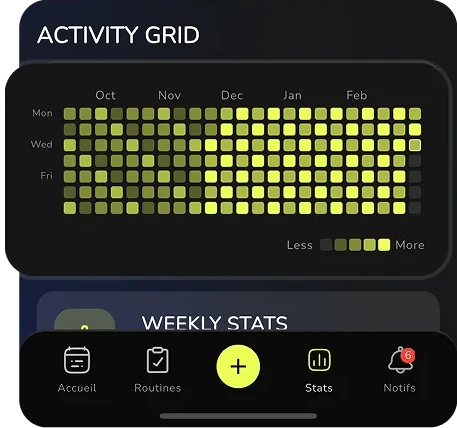
This is what the gym megastudy found and almost nobody applies. The day after a miss is the hardest day, and most systems punish it: your counter is at zero, the grid has a hole in it, and the app has quietly told you that you failed.
Give that day something instead. A reward, a small win, anything that makes coming back cheaper than staying away. If your system makes the return expensive, it works against the one moment that decides whether the habit lives. The case for gamified tracking, in a sentence.

What to do when motivation does turn up
Motivation is not the enemy. It is a poor thing to spend on daily effort, because it will not be there daily.
Spend it on setup. A motivated Sunday should buy you: the shoes by the door, the food in the fridge, the cue sentence written down, the tracker installed, the return rule agreed. Those hold for months. An hour of enthusiasm turned into a promise of an hour a day holds until Thursday.
Use the good days to lower the cost of the bad ones.
How long before it gets easy
Plan for two months, not three weeks. The 21-day figure came from a plastic surgeon’s note about patients adjusting to their new face in the 1960s. It has nothing behind it.
The real median is 66 days, and the range runs from 18 to 254. A glass of water after breakfast lands at the short end. A morning run does not. Mark day 66 on the calendar and judge nothing before it. If you expect ease at day 21 and it is still hard, you will decide the habit is not taking and quit five weeks early.
If yours keep dying before then, start with why habits are hard to stick to, or the full method in how to build habits. If your attention works differently, building habits with ADHD changes some of this advice. The research behind it all is worth twenty minutes.
Quick answers
Is consistency really better than motivation? Yes, but not because it is more virtuous. Repeating an action in the same setting makes it cheaper to do, until it costs almost no decision at all. Motivation cannot be repeated on demand. Consistency can be built.
What if I miss a day? Nothing happens. The UCL study found a single miss did not materially affect habit formation. Two in a row is the risk, so make the return rule now.
How do I stay consistent when I do not feel like it? Shrink the target until feeling like it stops being relevant. If your habit needs a good mood to happen, the habit is too big.
How long does it take to become consistent? Median 66 days, range 18 to 254. Judge it at two months, not three weeks.
Is it discipline, then? Less than people think. People with the best self-control resist temptation less often than everyone else, not more. They built the habit and removed the choice.
Where KUBBO fits
We built KUBBO around the fifth rule, because it is the one everyone skips.
Every habit you finish earns XP and Gold, and you spend them building a medieval city. Miss a day and nothing happens. Miss 48 hours and a building gets buried, which you dig out with Gold. You lose something, you get it back, and the city you spent three months on is still standing.

A streak asks you to be perfect and deletes everything the day you are not. A return assumes you will miss, and makes the next day the cheapest one to show up for.
Consistency over motivation is not something you decide. It is something you set up: one habit at a time, sized for your worst day, with a way back in.