
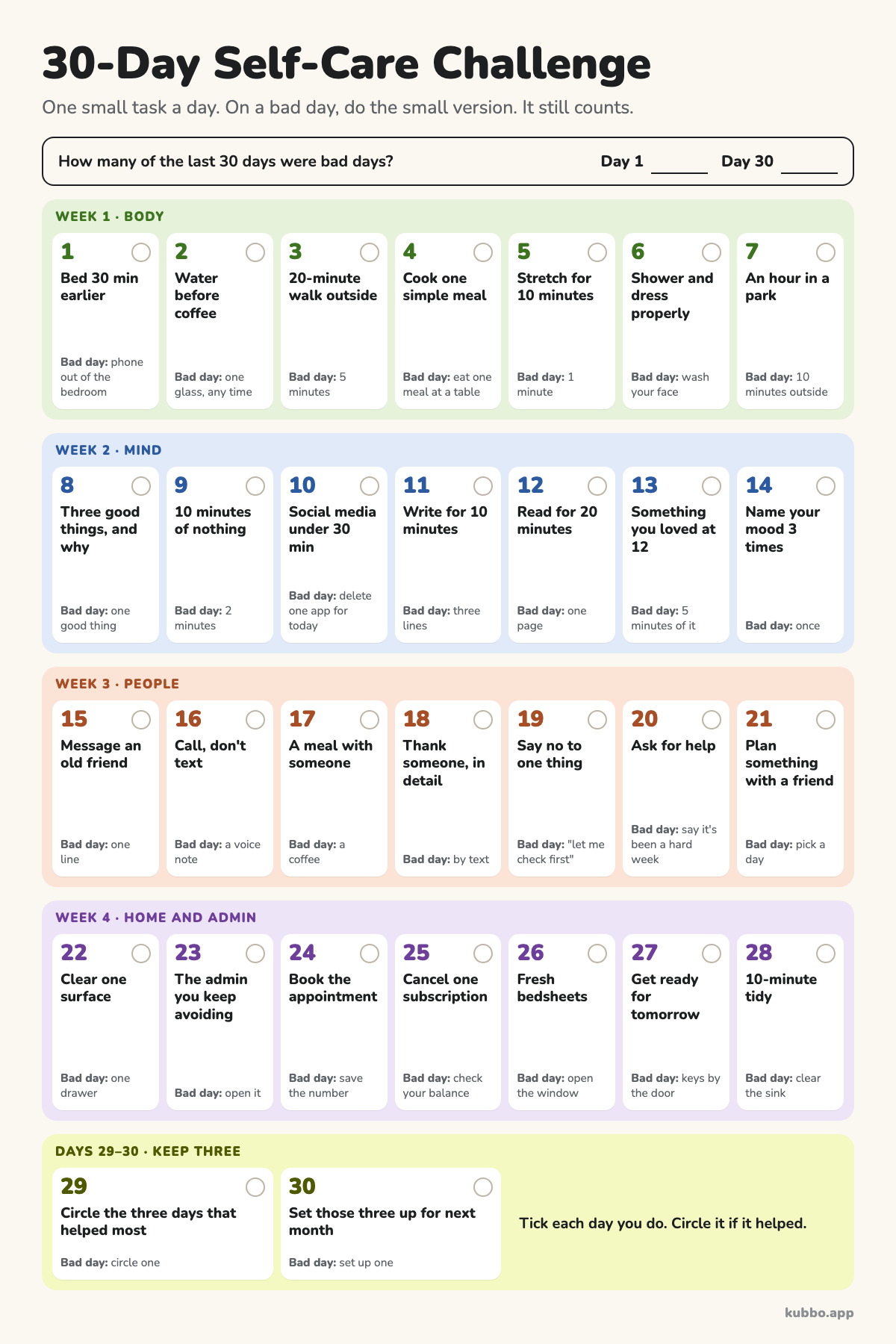
The calendar is below. Save it, print it, and start tomorrow.
Most self-care challenges you will find are lists of baths, face masks and candles. There is nothing wrong with a bath. But many of those lists are things to buy, and they leave out what makes a week feel better: sleep, food, a walk, a friend, the letter you have not opened.
This one works differently. Every day has a small version for bad days, and the small version counts. The month is a trial: you try 28 things and keep the three that helped. And you measure it with one question, on day 1 and again on day 30.
What self-care is, and what it is not
The World Health Organization’s definition is plain. Self-care is what you do to stay healthy, prevent illness and cope when you are ill, with or without a doctor’s help.
Nothing in it is about treating yourself. It is upkeep: sleep, food, moving, other people, and the dentist appointment you keep pushing to next month. That is what this calendar is made of.
Self-care is not a cure either. If most of your days have been bad for weeks, a challenge will not fix that. See a doctor. In the US you can call or text 988 at any hour.
How the challenge works
One task a day, one theme a week. Week 1 is your body, week 2 your mind, week 3 other people, week 4 your home and admin. Days 29 and 30 are for choosing what to keep.
Every task has a bad-day version. It takes two minutes or less, and it counts as a full day. You will have bad days in a month. A challenge that only works on good days ends on the first bad one. The idea comes from the 2-minute rule.
It is a trial, not a habit. Most 30-day challenges repeat one thing every day for a month. That is how you build one habit, and we cover it in 30-day challenge ideas. This one does the opposite: 28 different tasks, once each, so you find out which ones help you. Most will do little. Two or three will make a real difference, and you cannot know which until you try them.
Tick the day. Circle it if it helped. That is all the tracking you need. On day 29, the circles tell you what to keep.
Never miss twice. Missed a day? Do the next one tomorrow and let the missed one go. Do not double up to catch up. Two misses in a row is where most challenges end, as we explain in common mistakes that kill new habits.
Count your bad days, before and after. On day 1, answer one question: of the last 30 days, how many were bad days for your mental health, counting stress, low mood and worry? Write the number in the box at the top of the calendar. Ask again on day 30. The CDC asks American adults the same question every year in its health survey, and the large exercise study further down used it too.
Week 1: body (days 1–7)
Start with the body. Sleep, food and moving are dull, and everything else depends on them. After a short night, every other task on this calendar is harder.
- Day 1: Go to bed 30 minutes earlier. Bad day: charge your phone outside the bedroom. If your evenings vanish into your phone, read why you stay up when you know better first. → consistent sleep schedule
- Day 2: Drink a glass of water before your first coffee. Bad day: one glass, any time. → drink more water
- Day 3: Walk for 20 minutes outside. Bad day: five minutes round the block. → daily walking
- Day 4: Cook one simple meal. Eggs on toast counts. Bad day: eat one meal at a table, away from a screen. → meal prep
- Day 5: Stretch for 10 minutes. Bad day: one minute on the floor next to your bed. → daily stretching
- Day 6: Shower and get dressed properly, even if you are staying in. Bad day: wash your face and put on a clean T-shirt.
- Day 7: Spend an hour in a park, a wood or by water. Bad day: ten minutes outside.
Why an hour outside? Researchers at the University of Exeter asked almost 20,000 people in England how much time they spent in nature each week. People who spent at least two hours were more likely to report good health and wellbeing than people who spent none. Below two hours, the link disappeared. It did not matter whether the two hours came in one visit or in several short ones. Day 3 and day 7 together get you most of the way. It was a survey, so it shows a link, not proof.
Why so little exercise? A study of 1.2 million Americans found that people who exercised had about 1.5 fewer bad mental-health days a month than people who did not, which is 43% fewer. The best results came from 30 to 60 minutes, three to five times a week. More was not better: people who exercised more than 23 times a month, or for over 90 minutes at a time, reported more bad days. Day 5 does not need to be a workout.

Week 2: mind (days 8–14)
- Day 8: Write down three things that went well today, and why each one happened. Bad day: one thing. → gratitude practice
- Day 9: Ten minutes of nothing. No phone, no podcast, no plan. Bad day: two minutes. → meditation
- Day 10: Keep social media under 30 minutes. Set the limit in your phone’s settings before you start. Bad day: delete one app for the day. → digital detox
- Day 11: Write for 10 minutes about what is on your mind. Nobody reads it. Bad day: three lines. → journaling
- Day 12: Read for 20 minutes. A book, not a feed. Bad day: one page. → daily reading
- Day 13: Do something you loved at twelve. Draw, bake, build, play. Bad day: five minutes of it.
- Day 14: Name your mood in one word, three times today. Bad day: once.
Day 8 is the most tested task on this calendar. In 2005, Martin Seligman’s team asked people to write down three good things every evening for one week, and why each one happened. Compared with people who wrote about early memories, they were happier and less depressed, and the gap was still there six months later.
Day 10 has a trial behind it too. In 2018, researchers at the University of Pennsylvania asked 143 students to cut Facebook, Instagram and Snapchat to 10 minutes each a day for three weeks. Compared with students who carried on as usual, they ended up less lonely and less depressed, and the ones who started out most depressed gained the most. Nobody had to quit. A limit was enough. If day 10 helps you, it is one of the easiest tasks to keep.
Week 3: people (days 15–21)
Most self-care lists leave this week out, and it is the one people dread. Do it anyway.
- Day 15: Message a friend you have not spoken to in a while. Bad day: one line. “Saw this and thought of you” is enough.
- Day 16: Call someone instead of texting. Bad day: send a voice note.
- Day 17: Eat a meal with someone, phones away. Bad day: a coffee.
- Day 18: Thank someone for something specific. Say what they did and what it changed for you. Bad day: do it by text.
- Day 19: Say no to one thing you do not want to do. Bad day: say “let me check first”, then decide when you are calm.
- Day 20: Ask for help with one thing. Bad day: tell one person it has been a hard week.
- Day 21: Plan something with a friend. A walk, a film, a meal. Bad day: pick a day.
Why a whole week on other people? In 2010, researchers at Brigham Young University pooled 148 studies covering more than 300,000 people. Those with stronger ties to others had 50% higher odds of still being alive at the end of the studies. The authors put that on the same scale as well-known risks such as smoking. Calling a friend is health care.
If week 3 is hard because there is nobody to call, that is worth knowing too. Day 21 can be a class, a club, or a group that meets every week.
Week 4: home and admin (days 22–28)
This is the self-care nobody posts. You can think about an unopened letter ten times a day and still not open it. Dealing with one gives you a small, real relief.
- Day 22: Clear one surface. The desk, the counter, the chair with the clothes on it. Bad day: one drawer. → daily declutter
- Day 23: Do the admin task you have put off the longest. The form, the bill, the email you have owed since summer. Bad day: open it and write the first line.
- Day 24: Book the appointment you keep putting off. Doctor, dentist, eye test. Bad day: find the number and save it in your phone.
- Day 25: Cancel one subscription you do not use. Bad day: check your balance. → budget tracking
- Day 26: Put fresh sheets on the bed. Bad day: open the bedroom window for ten minutes.
- Day 27: Get ready for tomorrow tonight. Clothes, bag, lunch. Bad day: put your keys by the door.
- Day 28: Tidy for 10 minutes before bed. Set a timer and stop when it rings. Bad day: clear the sink.
The 1.2-million-person study counted housework as exercise. People who did chores still reported about 10% fewer bad days a month than people who did no exercise at all. A survey cannot prove the chores caused it, but it is a fair reason to count day 28.
Days 29 and 30: keep three
- Day 29: Look back and circle the three days that helped most. Not the ones you liked doing. The ones after which the day went better. Bad day: circle one.
- Day 30: Set those three up for next month. Bad day: set up one.
Then answer the question from day 1 again. Of the last 30 days, how many were bad ones? Compare the two numbers. If yours went down, you have three tasks that may be the reason. If it did not, you still found out which tasks did nothing for you, and you can drop them for good.
Setting up each of the three takes five minutes:
Give it a place in your day. Write one sentence: after [something you already do], I will [the task]. “After my morning coffee, I walk for 20 minutes.” A review of 94 tests with more than 8,000 people found that people who wrote down when and where they would act were clearly more likely to do it. Tie it to something that already happens, not to a time on the clock. Our guide to building habits covers the rest.
Keep the bad-day version. It got you through the month. It will get you through the next one.
Put it where you will see it. A paper grid on the fridge works. Our free habit tracker template prints one, with a 30-day challenge block if you want to run the next month as one.
Give it time. A month of trying things is not a habit yet. In a study at University College London, a daily habit took 66 days to feel automatic for the typical person, and anywhere from 18 to 254 depending on the person and the habit. The numbers are in how long it takes to build a habit.
When it goes wrong
You missed three days in a row. Start again where you stopped, not at day 1. The calendar is a list, not a set of dates.
A task does not fit your life. No park near you, nobody to eat with, no subscriptions to cancel. Swap it for another task from the same week, or repeat a day that helped.
You feel worse. Some days are meant to be uncomfortable: day 19 and day 23 are not fun. But if your count of bad days is going up, stop the challenge and talk to a doctor. In the US, call or text 988.
You stopped in week two, again. That is common, and it says more about the plan than about you. Why habits are hard to stick to goes through the reasons. If your attention works differently, building habits with ADHD changes several of the steps above.
Quick answers
What is a 30-day self-care challenge? One small act of care each day for thirty days. This one has four weekly themes (body, mind, people, home and admin) and two days at the end to choose what to keep.
What should I do each day? Follow the calendar above. Every day has a full task and a bad-day version that takes two minutes or less.
Is it better to do the same thing every day? To build one habit, yes. To find out what helps you, no. This challenge does the second. Once you know your three, do them every day.
Can I do it with a friend or partner? Yes, and week 3 is easier with two. Agree before you start on what you will do when one of you misses a day.
What if I miss a day? Let it go and do the next one. Never miss two in a row.
When should I start? On a date that feels like a new start: a Monday, the first of the month, or January 1st. Researchers at Wharton found that people take up new goals more often after dates like these.
Is there a printable version? Yes. Open the calendar above full size and print it. It fits on one page.
Is it a good idea in December? Yes. December is busy, which is what the bad-day versions are for. If you would rather have one small task for each day up to Christmas, our self-care advent calendar makes one for you to print.
Where KUBBO fits
We built KUBBO for the month after a challenge, when the calendar runs out and nothing tells you what to do next.
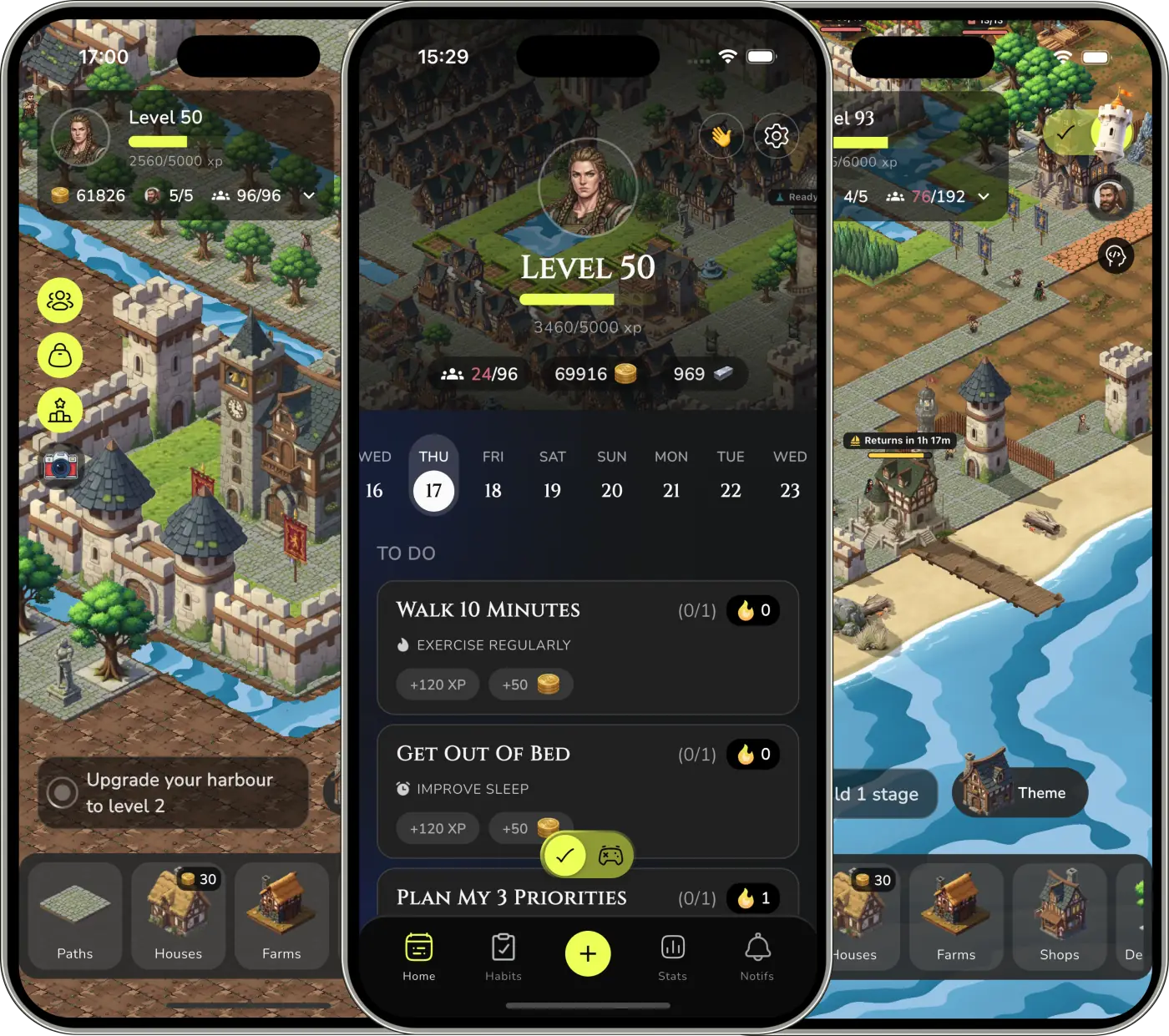
Put your three tasks in it. Every task you finish pays XP and Gold the moment you tap it, and the Gold builds a medieval city. Miss a day and nothing happens. Miss 48 hours and a building gets buried. You dig it out with Gold and carry on, and the rest of your city is still standing.
The research behind that design is in the science. If you want ideas for what to keep once the month is over, browse the habit guides.
Pick a start date. Print the calendar. Then do day 1, even the small version.