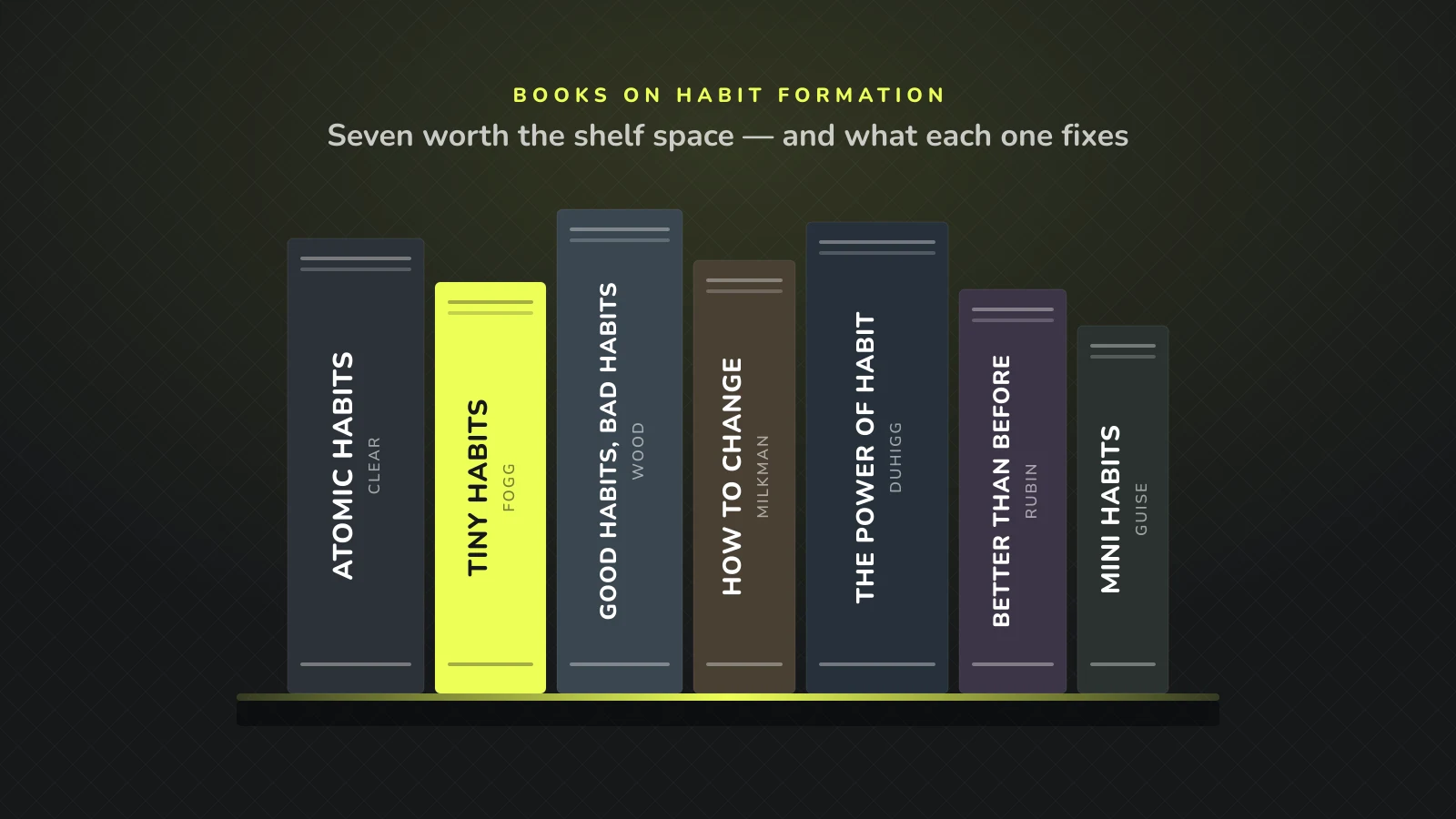
Search for books on habit formation and you get lists of thirty-three. Thirty-three books is not a reading list. It is a way of not starting.
You need one. Two at most. Seven books below, what each is for, and where each one pushes past what the research supports. I have read all of them and used a fair bit of what they say.
Pick by the problem, not the ranking
The books are not competing. They answer different questions, and the wrong one will bore you by chapter three.
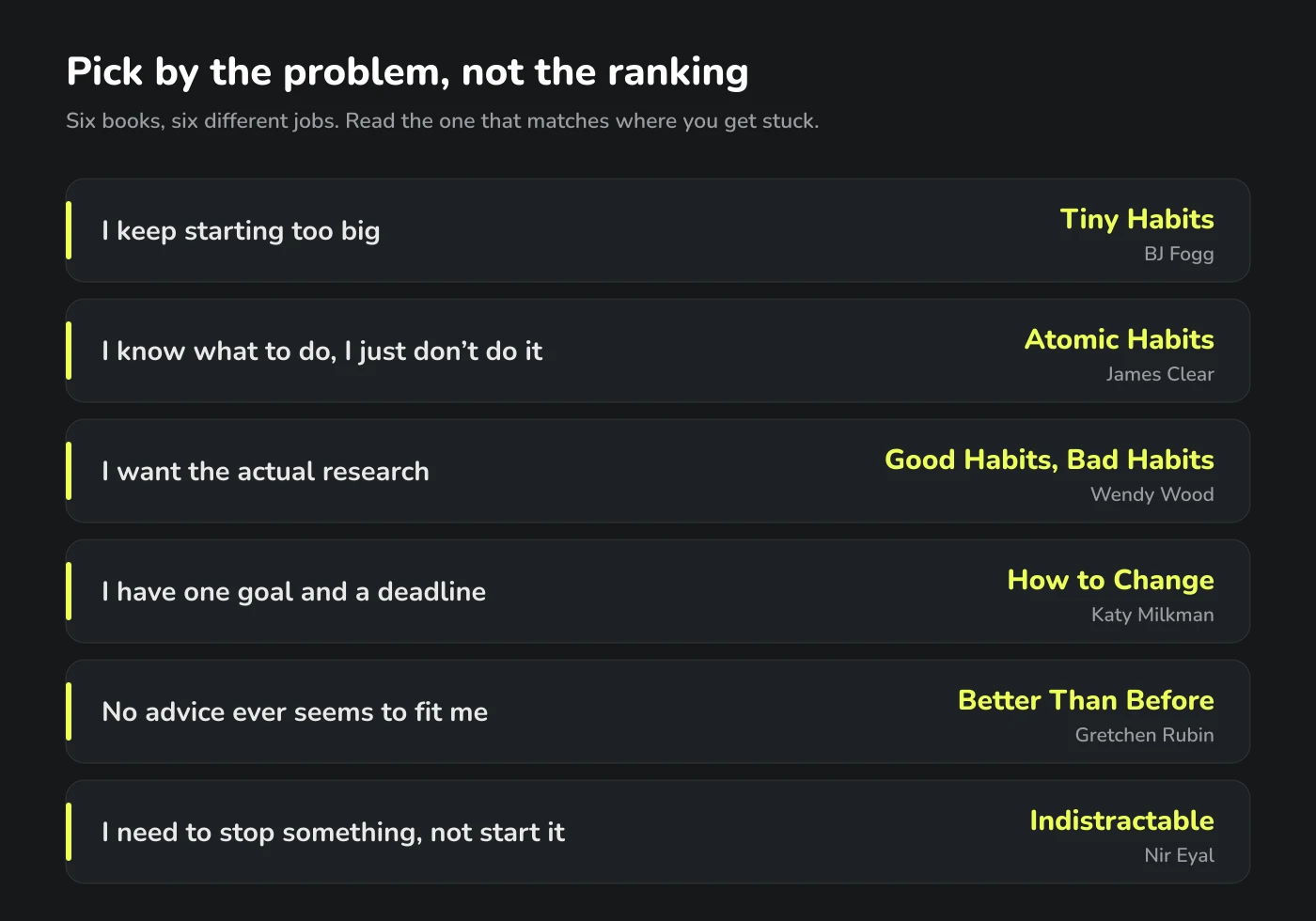
Find your line, read that book, ignore the rest until you need them.
Tiny Habits — BJ Fogg (2019)
Read it if you keep starting too big and quitting in week three.
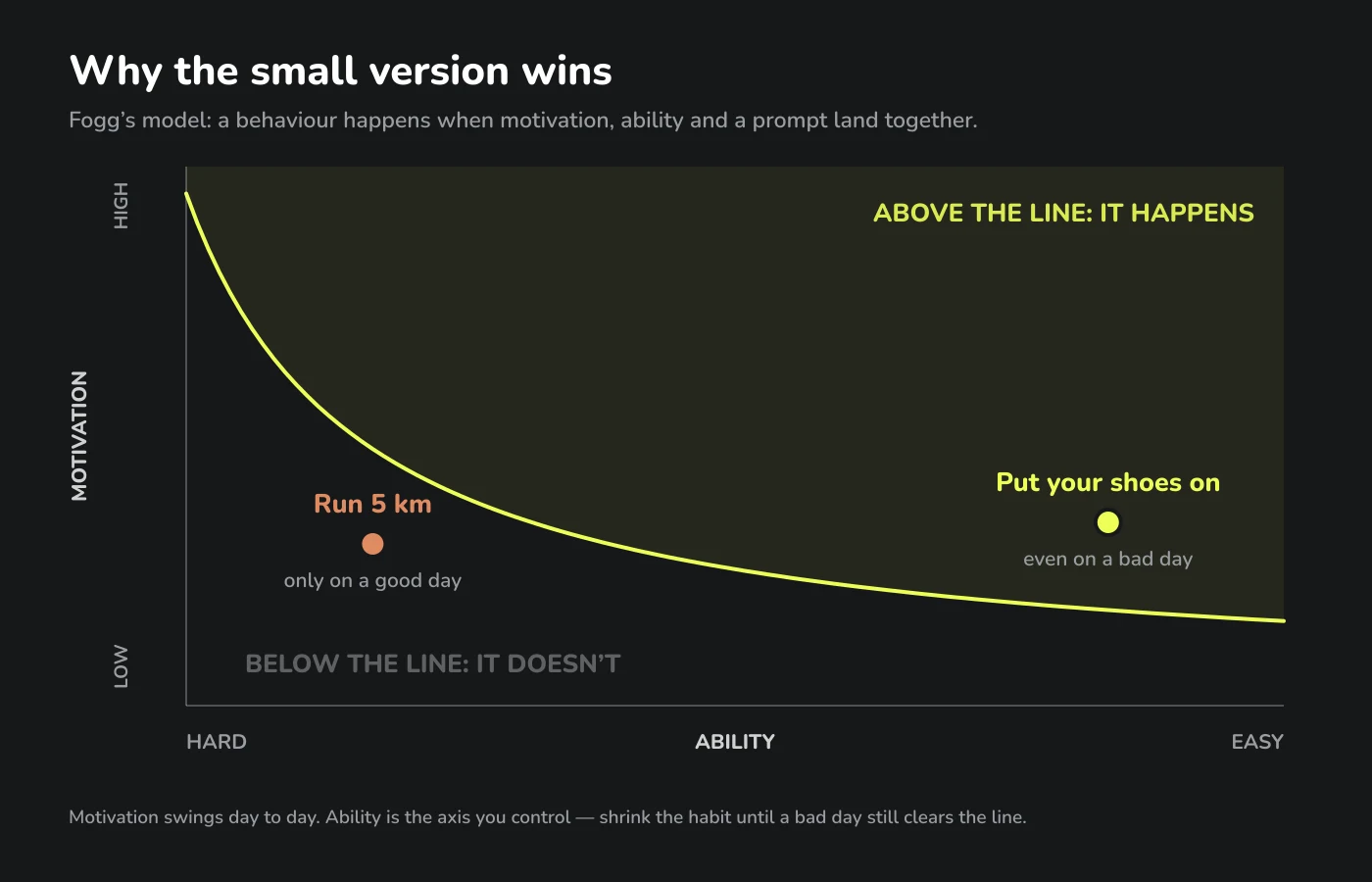
Fogg ran the Behavior Design Lab at Stanford and coached tens of thousands of people through his method before he wrote it down. His model is three letters: B = MAP. A behaviour happens when motivation, ability and a prompt arrive at the same moment. Take any one away and nothing happens.
What follows from that is the part you can use. Motivation swings. It is high on Sunday night and gone by Wednesday. Ability is the part you control. Shrink the habit until even a bad day clears the bar: two push-ups, one page, floss one tooth.
His recipe: After I [anchor], I will [tiny behaviour]. Then I celebrate. The celebration is the bit people skip and the bit Fogg cares most about: a small hit of good feeling, right after the act, while your brain is still paying attention.
Where it overreaches: the celebration step rests more on Fogg’s coaching than on trial evidence. It costs you nothing to try, so try it. Do not treat it as settled science.
If shrinking the target appeals, we wrote the smallest version of it in the 2-minute rule.
Atomic Habits — James Clear (2018)
Read it if you know what to do and still do not do it.
Thirty million copies and sixty languages later, this is the default. It deserves most of that. Clear takes twenty years of behavioural research and turns it into four steps you can act on the same afternoon: make it obvious, make it attractive, make it easy, make it satisfying. Habit stacking, the two-minute rule, environment design, identity-based habits. Most of what people now say about habits, they got from this book.
The best idea in it is not any of the four laws. It is this: you do not rise to the level of your goals, you fall to the level of your systems. Goals are the same for everyone in the race. What separates people is the process they run every day.
Where it overreaches: Clear is a writer summing up other people’s work, not a researcher reporting his own. The book sometimes borrows the authority of “studies show” for claims closer to reasonable guesswork. The 1% better every day maths is a nice picture, not a finding. None of that makes the advice wrong. It makes it advice.
If you want the method without the book, our guide to building habits covers the same ground in twenty minutes.
Good Habits, Bad Habits — Wendy Wood (2019)
Read it if you want the research, not a summary of it.
Wood spent thirty years studying habits at USC and published over a hundred papers on them. This is the one book on the shelf written by the person who ran the experiments.
Her central finding is uncomfortable: roughly 43% of what we do each day, we do in the same place at the same time, without deciding anything. Wanting things does not build habits. Setting and repetition do. The lever is not your resolve. It is your kitchen, your route home, where you keep your phone.
Her advice is unglamorous and works. Add friction to what you want less of. Remove friction from what you want more of. Change your surroundings and the behaviour follows without a fight. People who seem to have great self-control mostly have fewer temptations within reach.
Where it overreaches: almost nowhere, which is why it is the least fun of the seven. Wood hedges where the evidence is thin. If you want to be entertained, start elsewhere. If you want to be right, start here. We lean on her work in the science behind KUBBO.
How to Change — Katy Milkman (2021)
Read it if you have one goal, a deadline, and no idea which trick applies.
Milkman is a behavioural scientist at Wharton. The structure of her book is its best feature. Each chapter takes one obstacle (putting it off, forgetting, laziness, low confidence) and gives you the fix that matches. There is no single method here, and that is the point. The right tool depends on what is actually stopping you.
Two of her ideas have run through everything since.
- Temptation bundling: pair a thing you should do with a thing you want, and only allow the want during the should. She found her own version as a graduate student, when she could only get to the gym by saving her Harry Potter audiobooks for the treadmill. Her later trials showed the effect held up.
- The fresh start effect: Mondays, birthdays, the first of the month and New Year’s Day all make people more willing to try again, because they draw a line under the person who failed last time.
Where it overreaches: several of the effects come from big field experiments with small average results. Real, measurable, and smaller than the writing implies. Use them as nudges, not as engines.
The Power of Habit — Charles Duhigg (2012)
Read it if you want the story of how we started thinking about habits this way.
This is the book that put cue, routine, reward in front of a general audience, and it is still the most enjoyable of the lot. Duhigg is a reporter, and it shows in the best way: Febreze, Target working out that a customer was pregnant, a swimmer, a hospital, an aluminium plant.
Where it overreaches: keystone habits (the idea that one change, like making your bed or exercising, sets off a chain reaction through your whole life) is Duhigg’s own framing, not a research finding. He also draws large conclusions from single cases with the confidence of someone who has more data than he has. Fourteen years on, Wood and Milkman have both done the harder work. Read this one for the story, not the method.
Better Than Before — Gretchen Rubin (2015)
Read it if every piece of habit advice you have tried felt like it was written for somebody else.
Rubin’s claim is that there is no universal method, only methods that suit particular people. Her Four Tendencies split us by how we answer expectations: Upholders meet both inner and outer ones, Questioners need a reason, Obligers deliver for other people but not themselves, Rebels resist being told anything, including by themselves.
Obligers are the interesting group, and probably the largest. If you never miss a deadline at work but cannot keep a promise to yourself, you do not have a willpower problem. You have an accountability problem, and the fix is external: a training partner, a class you paid for, someone who notices.
Where it overreaches: the Four Tendencies is a self-report framework with no independent validation behind it. Treat it as a lens, not a diagnosis. It is still the fastest way to work out why the standard advice slides off you, which is the same reason we wrote a separate guide for building habits with ADHD.
Mini Habits — Stephen Guise (2013)
Read it if you want the whole idea in ninety minutes.
Guise self-published this and it is barely a book: one argument, stretched. The argument is good. Set the target so low it is stupid. One push-up. One sentence. Then do it every day. He is honest that he started with a single push-up because he was doing nothing at all, and that the extra reps came on their own.
Where it overreaches: it is one chapter’s worth of thinking. If you have read Fogg, skip it.
And one for the other direction: Indistractable — Nir Eyal (2019)
Every book above teaches you to start something. Stopping something is a different job, and this is the best book on it.
Eyal’s argument is that distraction does not begin with your phone. It begins with a feeling you would rather not sit in (boredom, anxiety, the small dread of a hard task) and the phone is only the nearest exit. So he works on the internal trigger first, then the schedule, then the apps.
Worth knowing: Eyal also wrote Hooked in 2014, the manual product teams used to build habit-forming apps in the first place. Reading both, in that order, is a strange and useful experience.
Two things to be careful with
Any habit book published before about 2016 that leans on willpower as a fuel tank rests on a finding that did not survive. The ego depletion effect (the idea that self-control drains like a battery and can be topped up with sugar) was one of the most cited findings in psychology. Then in 2016 twenty-three labs ran a preregistered replication with over 2,000 people and could not find it. Twenty-two of those labs had predicted beforehand that they would.
The practical version still holds: decisions are harder when you are tired and hungry. The mechanism sold in those books does not.
The second thing: any book promising a fixed number of days.
The 66-day number, properly
Most of these books quote the 66-day figure. It comes from Lally and colleagues at University College London, 2010, and it is worth knowing what it actually says.
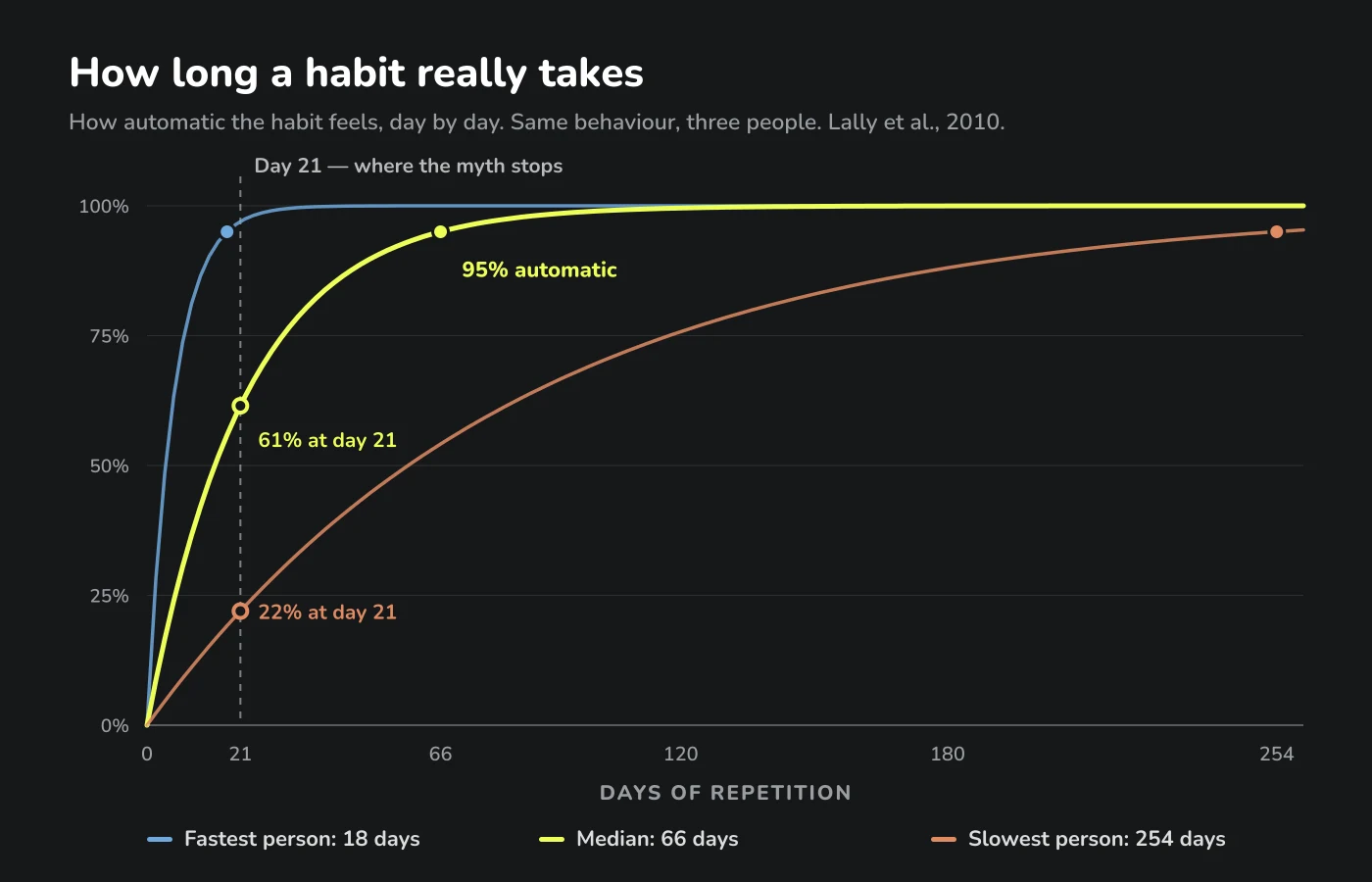
Ninety-six volunteers picked a daily behaviour and reported for twelve weeks. Of the eighty-two who finished, thirty-nine produced data that fitted the curve. For those thirty-nine, reaching 95% automatic took a median of 66 days, with a spread from 18 to 254.
Three caveats the books tend to drop:
- The study ran for 84 days, so the longer numbers are projections past the end of the data.
- The researchers measured how automatic a behaviour felt, and said so themselves.
- The 66 days describes fewer than half the people who took part.
What survives all that is the shape of the curve, and the shape is the useful bit. Early repetitions do most of the work. Progress slows without stopping. And missing one day did not measurably set anyone back, a finding almost every streak-based app ignores. More on that in how long it takes to build a habit and why habits are hard to stick to.
What the good ones agree on
Strip out the frameworks and the same five points remain:
- Make it small enough to survive a bad day. Fogg, Guise and Clear all say it. Wood’s research explains why it works.
- Attach it to a cue that already fires. After the coffee, after the laptop closes. A time of day is a weaker cue than an existing habit.
- Change the surroundings, not the resolve. Friction moves behaviour more reliably than intention does.
- Repeat it more than you think you need to. Two months, not three weeks.
- One miss is not a failure. Two in a row is where habits die.
If that list looks familiar, we wrote the long version as the mistakes that kill new habits.
The part no book can do for you
Every one of these books ends at the same wall. The method takes ten minutes to read. The repetition takes two months, and nobody is there to watch you do it.
That gap kills most habits, and it is not an information problem. You do not quit reading because you forgot the four laws. You quit because on day nineteen nothing has changed yet, the effort is now and the payoff is in March.
Two things worth doing. Count the action, not the result (did you go, yes or no), because results lag by weeks and will talk you out of a habit that is working. And put a reward on the same day as the work, so today’s ten minutes pays today.

That second one is what gamified habit trackers are for, and it is the whole design of KUBBO: finishing a habit earns XP and Gold, Gold builds a medieval city, and the city is still there on the mornings when motivation is not. Miss two days and a building gets buried. You dig it out with Gold, you lose something small, and you keep everything else. No wiped counter, no reason to give up in March.
How to actually read one
Pick the book that matches your problem. Read it once, quickly. Then choose one habit and one technique from it, and run them for eight weeks before you read anything else.
Reading five books about habits while building none of them is its own bad habit, and a comfortable one. It feels like progress and costs nothing. Start with reading itself if you like, or a daily walk. One habit, eight weeks, tracked.
Everything above is the theory. The full method is here, and it is free.