You told yourself that if you finished the tax return, you would book a weekend away. That was in February. The weekend is not booked, the tax return is not done, and you stopped thinking about either weeks ago.
The reward was fine. It was too far away. With ADHD, a reward three weeks off counts for very little next to what the next ten minutes offer, and the research agrees.
This guide is for adults who run their own reward system, with no parent or teacher in charge of the sticker chart. It covers why rewards work differently with ADHD, how to choose and size them, how to turn tasks into points, which rewards backfire, and what to do when the whole thing stops working after two weeks. Halfway down there is a reward menu you can print and fill in.
What is an ADHD reward system?
An ADHD reward system is a set of rules that pays you, straight away, for tasks you would otherwise put off. You choose the rewards in advance, match their size to the task, and collect them the moment you finish.
Most of what you find under this name is for children: sticker charts, token jars, a parent who hands out the prize. The idea is the same for adults. What changes is who runs it: you do the task, you check it, and you hand out the reward. Nothing stops you from taking the reward without doing the task, or from forgetting the system exists. A reward system for adults has to work on the days when the person running it is tired and would rather skip the rules.
Why rewards work differently with ADHD
A reward far away counts for less
Everyone values a reward less the further away it is. Pizza tonight beats a better pizza next month. Researchers call this delay discounting: how fast a reward loses value as it moves into the future.
With ADHD, it loses value faster. A 2016 review pooled 21 studies, with 3,913 people in all, that asked the same kind of question: a smaller sum of money soon, or a larger sum later? People with ADHD took the smaller, sooner sum more often than people without it. The gap was of medium size, and it did not differ between adults and children (Jackson & MacKillop, 2016).
Waiting feels worse
There is a second part. In a 1992 study, children with hyperactivity picked small rewards over large ones when the small choice made the session end sooner. They cared more about cutting the total wait than about getting more (Sonuga-Barke et al., 1992). A 2021 review of 37 comparisons, with 3,763 people, found the same pattern, and its authors explain it in part by a stronger than usual dislike of waiting (Marx et al., 2021).
So a reward system for ADHD has two jobs. Bring the reward close to the task. And cut the wait between finishing and getting it to almost nothing.
What the brain scans show, and what they do not
The study you will see quoted most is by Nora Volkow and her team, published in JAMA in 2009. They scanned the brains of 53 adults with ADHD who were not taking medication and 44 adults without ADHD. The ADHD group had less of two markers of dopamine, a chemical brain cells use to pass on signals about reward and drive, along the brain’s reward pathway. The markers are the parts of brain cells that catch dopamine and clear it away. Lower markers went with more trouble paying attention (Volkow et al., 2009). A follow-up on the same scans found that adults with ADHD scored lower on a questionnaire about drive to achieve, and lower markers went with lower scores (Volkow et al., 2011).
That finding is real, and it is narrower than the internet makes it. The study compares group averages, so it tells you nothing about one person’s brain. It did not test how people respond to rewards. And it does not say that ADHD brains “have no dopamine”. What it supports is modest: on average, the parts of the brain that handle reward and drive work differently with ADHD. The behavior studies above tell you what to do about it. The science page goes further into the brain side.
What this means for you
Not that you are lazy, and not that rewards fail with ADHD. They work. A review of 22 studies with 1,181 children found that rewards, or losing points for mistakes, helped children with and without ADHD do better on tasks, a little more so for those with ADHD. Children with ADHD also preferred their rewards straight away (Luman et al., 2005).
The problem is the gap. A reward next month cannot compete with what your phone offers in the next ten seconds. A reward in the next ten seconds can. Every brain weighs cost now against reward now, and we go through that sum in how to stop being lazy. ADHD makes the “later” side count for even less.
What counts as a reward
A reward has to pass three tests.
Small. You can afford it every day: in money, in time and in health. If it costs too much to give often, you will stop giving it.
Instant. You can start it within a minute of finishing. If it needs a trip to the store, it is a medium or big reward, not the one that gets you through the dishes.
Real. You want it today, not in theory. “A treat” is not a reward. “The cinnamon roll in the freezer” is. And if you would have it anyway, task or no task, it does not count, unless you make it something you only get after.
Ideas, by type:
- Taste: a square of good chocolate, the nice coffee, a cold fizzy drink, fruit you like.
- Senses: one song played loud, a hot shower, hand cream that smells good, five minutes in the sun.
- Play: one round of a game, one crossword, one level.
- People: a message to a friend, a call to your sister, ten minutes with the dog.
- Rest: five minutes lying on the floor, a short nap, one chapter of a book.
- Small buys: a song, a sticker, a new pen. Keep these rare and cheap.
Three sizes: tiny, medium and big
Not every task deserves the same reward. Use three sizes.
| Size | When | Example | Price |
|---|---|---|---|
| Tiny | Right after each task | One song, one square of chocolate | 1 to 3 points |
| Medium | After a hard task, or at the end of a good day | One episode, a coffee out, an hour of a game | 10 to 20 points |
| Big | Every one to four weeks, planned | A concert ticket, a day trip, new running shoes | 50 to 150 points |
The tiny ones do most of the work. They come often and arrive within a minute, so they get you through the task in front of you. The big ones do not move you on any given day. Their job is to give your points somewhere to go, so that saving them leads to something.
Match the size to how much you dread the task, not to how long it takes. Emptying the dishwasher takes ten minutes and you may not mind it. A two-line email to your landlord takes two minutes and you may have dodged it for a week. The email earns more.
Pay the moment you finish
Timing matters more than size. A tiny reward now beats a medium one tonight.
- Set it up before you start. Put the chocolate on the desk, queue the song, leave the game open. If getting the reward takes effort, you will skip it, and then the task paid nothing.
- Hand it over within a minute. Finishing and getting the reward should feel like one event.
- Reward the start, if starting is the problem. For a task you have put off for weeks, pay for the first two minutes, not the finish. The 2-minute rule shows how to shrink a task that far.
- Pay for the action, not the result. Reward the walk, not the weight you lose. You only control one of them.
Turn it into points
Not every reward can be instant. Points fix that. Writing “+3” takes two seconds and happens the moment you finish. The coffee or the concert comes later, but the points are already yours.
- Give each task a value. 1 point for something easy that you keep skipping. 3 for something annoying. 5 for the task you have avoided for days.
- Price every reward in advance. Tiny ones cost 1 to 3 points, medium ones 10 to 20, big ones 50 to 150.
- Write the points down the moment you finish. On paper, in an app, on a sticky note on the fridge. Seeing the number go up is the instant part.
- Spend when you like. A tiny reward straight away, or save for a bigger one.
- Never take points away. No fines for missed days. If the system can only give, you will keep looking at it. If it can take, you will start to avoid it.
A day might look like this:
| Task | Points |
|---|---|
| Take out the trash (you keep forgetting) | 1 |
| Answer two work emails you have been dodging | 3 |
| Book the dentist | 5 |
| 10-minute walk | 1 |
| Total | 10 |
You spend 2 points on one loud song after the dentist call, 2 on a square of chocolate after the emails, and keep 6. At that rate a medium reward comes every two or three days and a big one every few weeks. If the big one feels out of reach, cut its price. A system you never cash in is a system you will stop using.
Make your reward menu in advance
Choose your rewards on a calm day, not at the moment you need one. At 4 pm after a bad meeting, you will not think of the good options, and “just check my phone” will win. A list written in advance does the choosing for you.
Print the menu below, or copy it onto paper. Fill in five or six rewards per column and give each a price. Put it where you do the tasks you avoid: the fridge, the desk, the inside of a cupboard door.
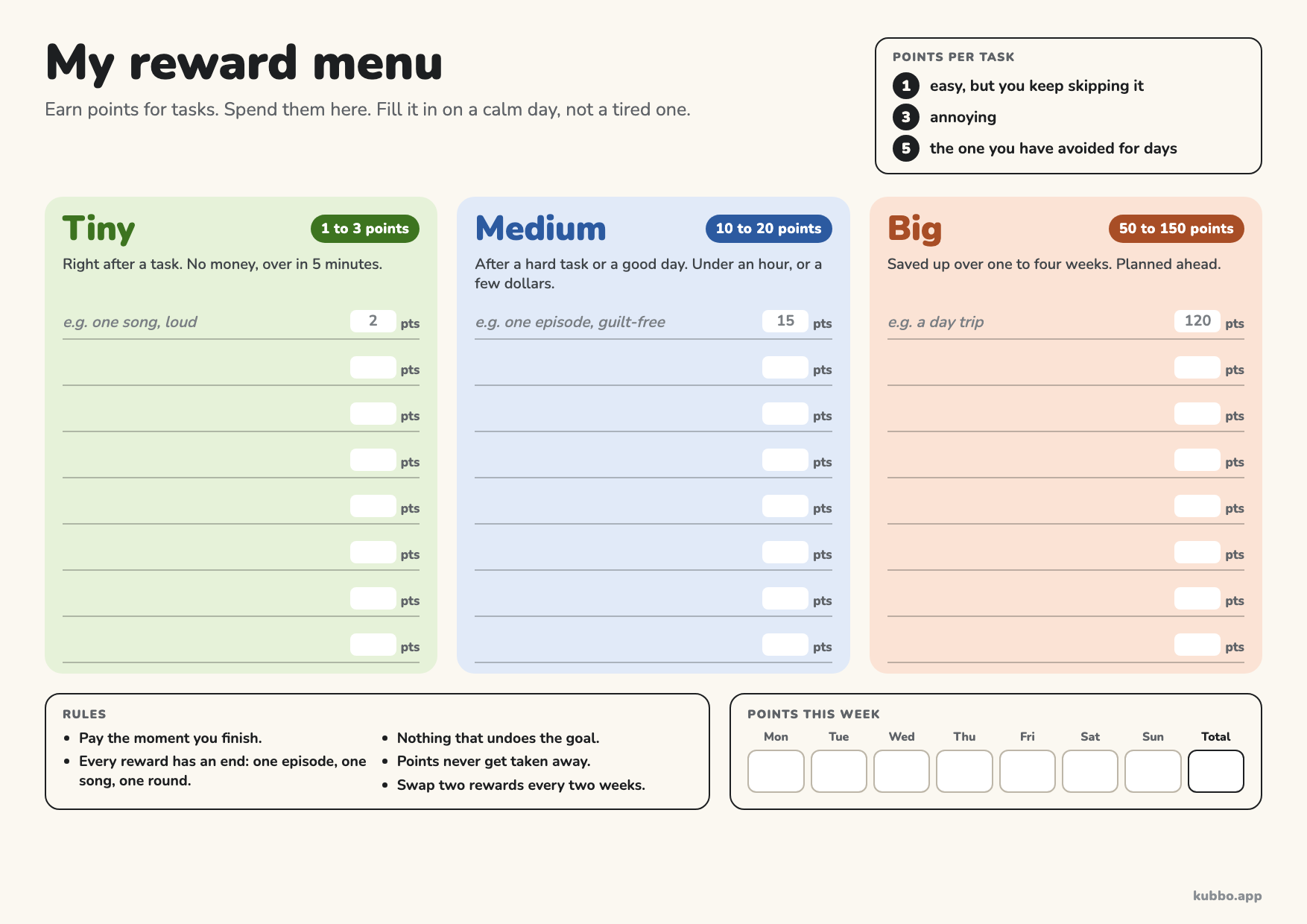
You may have seen the “dopamine menu”, a list of pleasant things to do when you feel flat. A reward menu is different: every item has a price, and you only get it after a task.
Rewards that backfire
Some rewards cost more than the task was worth.
Rewards with no end. “Five minutes on my phone” is how a lot of evenings vanish. Social media, video sites and endless games work hard to keep you there, and a reward you cannot stop is no longer a reward. Choose rewards that end on their own: one episode, one song, one round, one chapter. If you want phone time, put it at the end of the day, after the last task, with an alarm in another room.

Rewards that undo the goal. Cake after a run, when the run was for weight. A shopping trip for sticking to a budget. A late night of TV as the reward for a day that was meant to fix your sleep. Pick rewards that help the goal, or at least do not hurt it.
Rewards you were going to have anyway. If you always have coffee at ten, coffee at ten is not a reward. Make the good coffee, or the café, depend on the task instead.
Rewards too big for the task. A $40 purchase for doing the laundry feels great once. Then it becomes a cost you feel guilty about, and then a reason to drop the system. Keep the size matched to the task.
Taking the reward without the task. It will happen. Do not add a punishment. Note it and look at why. Often the task was too big to start. Shrink the task, or make the next reward easier to earn.
Pair the task with something you only get during it
Sometimes the best reward comes during the task, not after it.
Katy Milkman and her team at the Wharton School ran a study with 226 students and staff who used a university gym. One group got gripping audiobooks they could only listen to at the gym. At first, that group went 51% more often than a control group. The effect faded over the weeks, most of all after the Thanksgiving break. When the study ended, 61% of the people in it chose to pay for audiobooks they could only use at the gym (Milkman, Minson & Volpp, 2014). The researchers called it temptation bundling: tying something you want to something you should do.
A later study with 6,792 people found a smaller effect that lasted longer. People who got an audiobook and heard about the idea were 10 to 14% more likely to work out in a given week than people who got neither, during a four-week program and for up to 17 weeks after it (Kirgios et al., 2020).
Ways to use it:
- A podcast you only play while doing the dishes.
- One playlist that only comes on for paperwork.
- A show you only watch on the exercise bike.
- The good coffee, only at your desk while you do the forms.
Two rules. The pleasure has to be something you want, and you have to keep it for that task only. If you play the podcast in the car too, it no longer gets you to the sink. Cleaning is where many people start: cleaning with ADHD has a schedule built for bad weeks.
Keep it new
The same reward wears off. The chocolate that felt like a prize in week one is just chocolate by week three. It happens to everyone: in the gym study, the audiobooks worked less well as the weeks went by.
Three ways to keep rewards fresh:
- Rotate. Swap two items on your menu every two weeks.
- Add chance. Number six tiny rewards and roll a die. Luxi Shen, Ayelet Fishbach and Christopher Hsee found that more people finished drinking 1.4 liters of water in two minutes when the prize was a coin toss between $1 and $2 than when it was a sure $2 (Shen, Fishbach & Hsee, 2015). Not knowing made the task more exciting, as long as people were focused on the task rather than the prize.
- Hide one. Put a small reward in an envelope and open it only when the dreaded task is done.
Keep chance to the tiny rewards. Slot machines pay out at random too, so keep the prizes small and the rules fixed.
Do rewards kill motivation?
You may have read that paying yourself for something makes you like it less. That is partly true, and it matters less than it sounds.
In 1999, Edward Deci, Richard Koestner and Richard Ryan pooled 128 experiments. When people expected a reward like money or a prize for something they already found interesting, they later chose to do it less on their own. Psychologists call this the overjustification effect. But the same review looked at the studies that tested both interesting and dull tasks. For dull tasks, the drop did not appear. And praise for doing well made people more interested, not less (Deci, Koestner & Ryan, 1999).
So keep rewards off what you already love: painting, reading for fun, the guitar. Put them on the forms, the dishes, the emails and the phone calls. Nobody does their taxes for love, so there is nothing for a reward to spoil.
When you stop caring after two weeks
Many reward systems feel great for about two weeks and then fade. You forget to write the points, the menu falls behind the fridge, and one day you notice you stopped. This is normal. New things wear off for everyone, as the audiobooks did at the gym.
What helps:
- Change the rewards, not the system. Rewrite half the menu. New rewards bring back most of the interest.
- Run it in rounds. Four weeks per round, with a new menu and a new big reward each time. An end date turns it into a game you can finish.
- Restart small. If you stopped for a week, start again with one task and one tiny reward. No catching up on missed points, and no debt.
- Retire tasks that no longer need it. Some tasks become habits; research puts that at about two months on average, with wide variation. A task you do without thinking does not need points. Give them to a new one.
- Let something else do the counting. Writing points by hand is one more step to forget. An app that adds them when you tick the task removes that step.
If your systems keep stopping at the same point, the common mistakes that kill new habits may look familiar.
Set up your ADHD reward system this week
- Tonight, list three tasks you keep putting off. Give each 1, 3 or 5 points.
- Print the menu. Fill in at least four tiny rewards, two medium and one big, with prices.
- Put two tiny rewards where you will do tomorrow’s first task.
- Tomorrow, do one task, write the points, and take a tiny reward within a minute.
- On Sunday, add up the week. Buy a medium reward if you have the points.
- In two weeks, swap two rewards.
Rewards help you start and keep going. They do not replace an assessment or treatment. If ADHD gets in the way at work or at home, talk to a doctor or psychologist.
Quick answers
What are good rewards for adults with ADHD? Small, real and quick to start: one song, a square of good chocolate, one round of a game, a message to a friend, five minutes outside. Keep bigger ones, like a concert or a day trip, for points you have saved.
Do reward systems work for adults with ADHD? Most studies are on children, where rewards help, a little more so with ADHD. There is less direct testing in adults. But the main reason rewards have to be instant, that rewards far away count for less, shows up in adults as much as in children.
How do I reward myself without overdoing it? Choose rewards that end on their own, price them in points, and set the prices before you need them.
Is it bad to reward yourself with food? Not in small amounts, as long as the food does not undo the goal. If the goal is about weight or health, pick rewards from the other lists.
Can I use money as a reward? Yes. Some people move a set amount per task into a “fun” account. Keep the sums small and spend them on things from your menu. Otherwise it turns into saving, which is a far-away reward again.
What is a dopamine menu? A list of pleasant things to pick from when you feel flat or bored, a term from ADHD coaching. It is not the same as a reward menu: it has no prices, and no task comes first.
Why does my reward system stop working? Usually the rewards got old, the reward came too late, or a missed day turned into a missed week. Change the rewards, cut the wait, and restart small.
Should I punish myself when I skip a task? No. Taking points away turns the system into something to avoid. Missing the reward is enough.
Where KUBBO fits
KUBBO is a points system that is already built. Every task you tick pays XP and Gold at once, so the “write down the points” step happens on its own. You spend the Gold on a medieval city: houses, farms, towers. That covers the tiny tier, and what you can build changes as you level up, which helps when week three comes round.
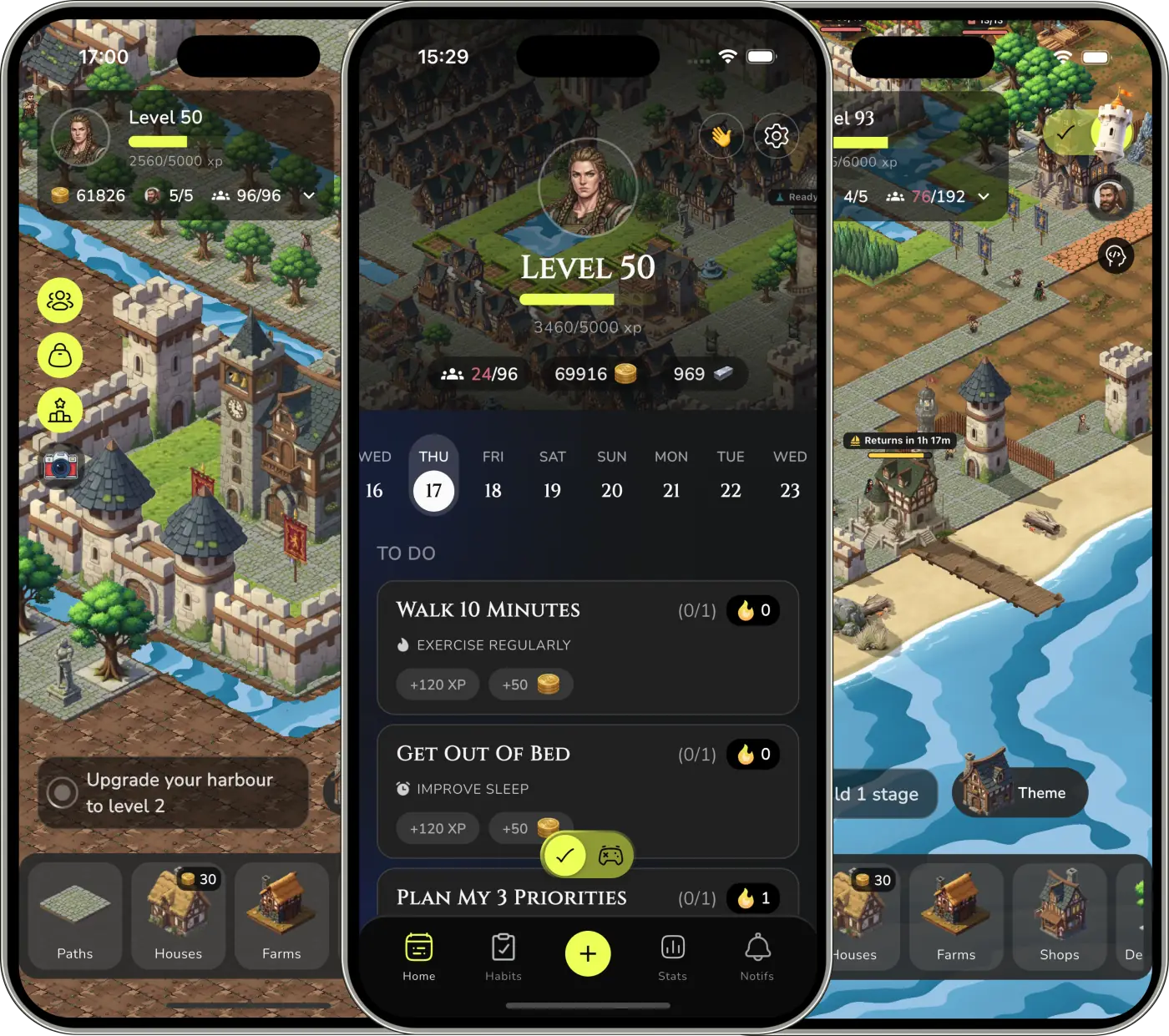
Miss 48 hours and a building gets buried. You dig it out with Gold and carry on. The cost is small: a shovel, not your city.
KUBBO’s Gold buys buildings, not coffee. Keep your paper menu for the medium and big rewards, and let the app handle the small ones. To see how this compares with a plain checklist app, read what an ADHD habit tracker does differently.
Keep reading
- How to build habits with ADHD: the short guide, with instant rewards as one of five strategies.
- The ADHD morning routine that survives a bad morning
- Gamify your life, and does gamification help build habits? for what the research says.
- The best habit trackers for ADHD
- A free printable habit tracker to put next to your reward menu.
- The procrastination test, if starting is where you get stuck.