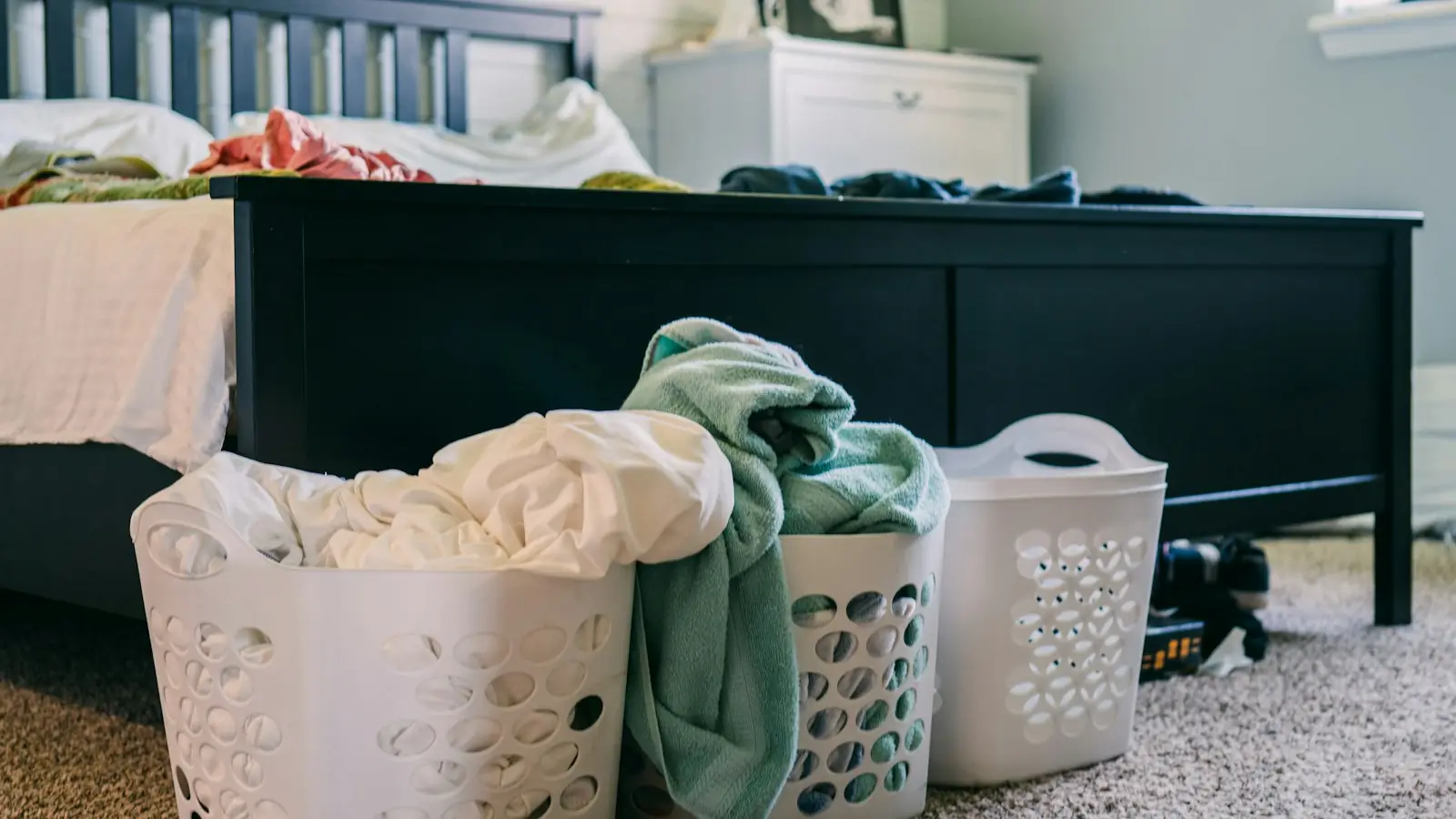
On Saturday you clean for five hours. The kitchen shines, the floor is clear, you can see the bottom of the laundry basket. Three weeks later you cannot find a clean fork, and you wonder how it got this bad again.
The usual advice does not help. “Clean as you go.” “Do a little every day.” Each tip takes for granted the part you find hardest: that you will remember, start and keep going with nothing to prompt you.
This article starts from how an ADHD brain handles housework instead.
Why is cleaning so hard with ADHD?
Because cleaning is made of the very things ADHD gets in the way of.
ADHD is in large part a problem with the brain’s planning skills: starting a task, keeping its steps in mind, tracking time, sticking with something dull. Doctors call these skills executive function. As Understood, a US nonprofit, puts it: “People with ADHD who have a hard time keeping things tidy usually aren’t being lazy or thoughtless.”
Here is how each skill shows up in a house.
Starting. “Clean the kitchen” has no first step. It is forty small jobs at once, so you look at it, see all forty, and walk away.
Holding the steps. Cleaning a room means keeping a plan in mind while your hands do something else: this to the sink, that to the bedroom, then back for the floor. That plan sits in working memory, what you can hold in mind for a few seconds while you act. A review of 38 studies found that adults with ADHD score lower on working memory tests than adults without it, by a moderate margin (Alderson et al., 2013). So you carry a mug to the kitchen, see the mail, start reading it, and you never finish the bedroom.
Out of sight, out of mind. Online, people call this “ADHD object permanence”. The term comes from research on babies, and it is not quite right: you know the vacuum still exists. What fails is the reminder. Nothing brings the cupboard under the sink, or the wet laundry in the machine, back to mind until you see it. And a pile you walk past every day soon stops catching your eye.
Time. Many adults with ADHD say they cannot tell whether a job takes five minutes or an hour. The research is thinner than the internet suggests: a 2023 review found few studies on how adults with ADHD judge time, some showing clear problems and some none (Mette, 2023). Either way, if you guess the dishes take an hour, you put them off.
Boredom. Cleaning is the same task, again, with no end. In a small 2025 study, young adults with ADHD traits rated themselves far more prone to boredom than their peers (Orban et al., 2025). Next to a phone, a sink of dishes has nothing to offer.
All or nothing. Put those together and you get a familiar pattern: nothing for weeks, then a five-hour clean because guests are coming or the plates have run out. The big clean wears you out and teaches you that cleaning costs a whole Saturday, so you put the next one off even longer.
None of this is a flaw in your character. You cannot change your brain by Saturday, but you can change the job.
How to keep a clean house with ADHD: plan for your worst week
Most cleaning schedules assume a good week. They work while you sleep well and nothing goes wrong. Then a bad week comes, you miss three days, and the schedule turns into a list of things you failed at. You stop looking at it.
Build for the bad week instead. Ask of every task: could I still do this after five hours of sleep and a long day? If not, write a version you could. Two ideas make that work.
A floor. The floor is the least that keeps your home working, the part you keep up even in your worst week: a clean plate, cup and fork; no food going off; bins that are not overflowing; a clear path to the bed and the door; clean underwear for tomorrow. Above that, everything is a bonus. KC Davis, a therapist and the author of How to Keep House While Drowning, sets the same goal: “The only thing that actually matters is whether my house is functioning and whether I’m able to live the kind of life I want to inside of it” (NPR, 2023).
One zone first. In a popular Reddit thread on cleaning with ADHD, one answer puts it simply: “pick ONE section of the house that you feel is the most important to keep clean, and work on that until you have a system”. For many people that is the kitchen sink, because it decides whether you can eat at home. Keep that one zone clear for two or three weeks before you add a second.
A sink you keep clear for three weeks teaches you more than a whole-house plan you drop on day four. The same goes for any habit: see how to build habits with ADHD.
ADHD cleaning tips that hold up on a bad week
1. Clean by the clock, not by the job
“Clean the bathroom” never feels finished, so it is hard to start. “Fifteen minutes in the bathroom” ends when the timer rings. Set one, start with whatever is closest, and stop when it rings, even halfway through a task. You learn that cleaning costs fifteen minutes, not a Saturday, and the next start gets easier.
Time a few jobs once and write the numbers down; the printable below has a row for this. Emptying the dishwasher is easier to start once you have seen that it takes, say, four minutes. If fifteen minutes is still too much, use the 2-minute rule.
2. Keep tools where the mess happens
If the cleaning spray lives in a closet down the hall, you wipe the bathroom sink about as often as you think of that closet. Keep a spray and a cloth under every sink. Put a bin in every room that makes trash, and a hamper where clothes come off, not where they “should” go. Open shelves and clear boxes beat drawers for anything you need to see to remember. Owning less helps too: see the daily declutter habit.
3. Do not leave the room
Every trip out of the room is a chance to start something else. Davis makes the same point: “the more times you leave that room, the more likely you are to get distracted”. Carry a basket. Anything that belongs somewhere else goes in it, and you take the basket out once, at the end.
4. Tie each task to something you already do
A task with no set time depends on you remembering it, which is the weak spot. Tie it to something that already happens every day:
- After I brush my teeth, I wipe the sink.
- While the kettle boils, I empty the dish rack.
- After dinner, I take the trash to the door.
The habit you already have does the remembering. Doing some of the work the night before helps for the same reason, as in the ADHD morning routine.
5. Clean with someone there
Body doubling means doing a dull task while someone else is around: a friend on a call, a housemate in the same room, a “clean with me” video. Many people with ADHD say it helps them start and keep going. The research is thin: a 2024 survey of 220 people found that those who use it do so for study, work, dishes and cleaning, mostly to get going and stay on task (Eagle et al., 2024). That shows how people use it, not whether it works. It costs nothing to try.
6. Pay yourself the moment you finish
A clean kitchen pays you a little at a time over the next week. Your brain counts what arrives now. Keep a podcast you love for cleaning only, or follow each zone with a small treat. With ADHD, a reward has to arrive at once and stay worth having: our guide to building an ADHD reward system shows how, and how to stop being lazy covers the research on pairing a chore with something you enjoy.
7. Count days out of ten, not days in a row
You will miss days. A streak turns one miss into a reason to quit. Count how many of the last ten days you kept your floor instead. Seven out of ten is a home that works.
A printable ADHD house cleaning schedule
This is the ADHD cleaning list we would hand a friend: the floor, a 10-minute daily list, one zone a day, one bigger job a week, a row to time common jobs, and the reset order for a room that has got away from you. Every task has a bad-week version under it. On a bad week, do the small version and tick the circle anyway.
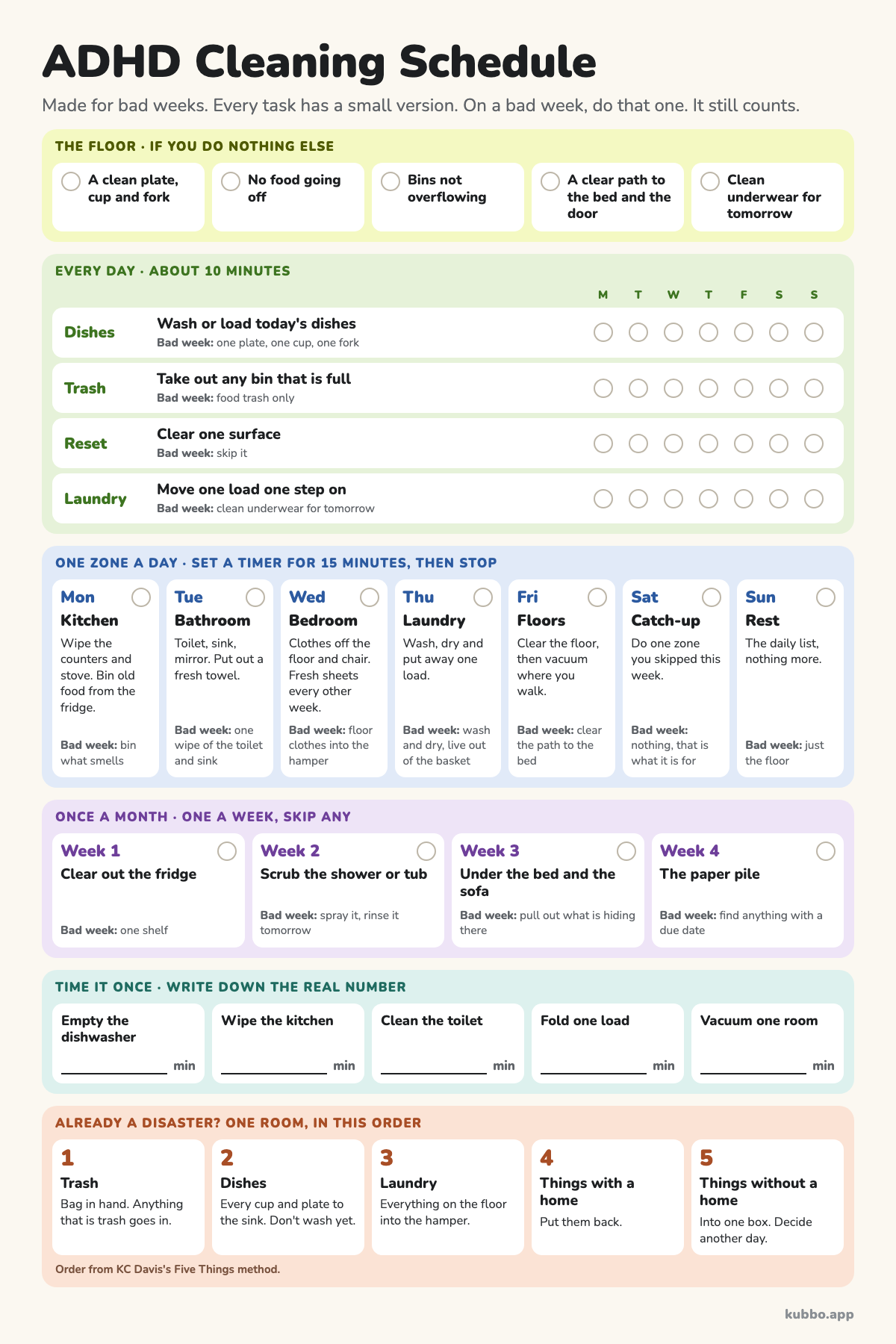
Here is the weekly part in text, if you want to copy it into your own planner:
| Day | 15-minute version | Bad-week version |
|---|---|---|
| Mon Kitchen | Wipe the counters and stove, bin old food from the fridge | Bin what smells |
| Tue Bathroom | Toilet, sink, mirror, a fresh towel | One wipe of the toilet and sink |
| Wed Bedroom | Clothes off the floor and chair, fresh sheets every other week | Floor clothes into the hamper |
| Thu Laundry | Wash, dry and put away one load | Wash and dry, live out of the basket |
| Fri Floors | Clear the floor, then vacuum where you walk | Clear the path to the bed |
| Sat Catch‑up | One zone you skipped this week | Nothing, that is what it is for |
| Sun Rest | The daily list, nothing more | Just the floor |
Move the days around to fit your week. If Wednesday is your longest day, give it the smallest zone.
The monthly jobs rotate one a week: fridge, shower, under the furniture, then the paper pile. The paper pile matters more with ADHD than it looks, because it is where the unpaid bill hides. On a bad week, just find anything with a due date.
If you would rather track the schedule than print it, our free habit tracker template works with the same zones.
When the house is already a disaster
If every room is bad, a weekly schedule is the wrong place to start. Reset one room first, then let the schedule keep it that way.
Pick the room you use most, usually the kitchen or the bedroom, and go through it in the order of KC Davis’s Five Things method. She says there are only five kinds of things in any room: “trash, dishes, laundry, things that have a place and things that don’t have a place” (NPR, 2023).
- Trash. Take a bag and pick up everything that is trash. Do not take it out yet.
- Dishes. Every cup, plate and bowl goes to the sink or into a basket. Do not wash them yet.
- Laundry. Davis’s rule: “if it’s on the floor, it’s going into the hamper, and it’s getting washed.”
- Things with a home. Put them back.
- Things without a home. Put them all in one box. Decide about them another day.
Each pass asks one question about every object: is this trash? Is this a dish? You never have to decide where to begin or what comes next, which spares your working memory. And trash, dishes and clothes often make up most of the mess, so the room looks different after three steps.
ADHD bedroom cleaning checklist
The same method for a bedroom, step by step:
- Open the curtains and a window.
- Bag: wrappers, receipts, tissues, empty bottles.
- Every cup, glass and plate to the kitchen, in one trip.
- Every piece of clothing on the floor or the chair into the hamper, clean or not. Washing a clean shirt again takes less effort than deciding whether it is clean.
- Chargers, books, shoes and bags back where they live.
- Everything else into one box. Write the date on it.
- Pull the duvet up. That counts as making the bed.
Bad-week version: steps 2 and 4, ten minutes, then stop.
When it is more than one room can fix
Sometimes the mess points to something else:
- You cannot let things go. In a 2022 study of 88 adults at an ADHD clinic, about one in five had serious hoarding symptoms, against 2% of a similar group without ADHD. The link was with inattention, and the authors note that people with ADHD rarely bring it up themselves (Morein-Zamir et al., 2022). If boxes are filling rooms and throwing things away feels impossible, tell your doctor.
- You cannot do anything at all. If the mess comes with weeks of low mood and no interest in things you used to enjoy, the problem may be depression, not the house. Talk to a doctor.
- You can pay for help. Paying a cleaner to reset the house once is not a failure. Neither are paper plates in a hard month. What matters is that your home works, not how it got there.
Quick answers
Do people with ADHD struggle with cleaning? Many do. Cleaning leans on the skills ADHD affects most: starting tasks, keeping steps in mind, noticing what is out of sight, judging time and putting up with boredom. It is not a sign of laziness.
How do people with ADHD clean their house? In short bursts with a timer, one zone at a time, with tools kept where the mess happens. A small daily minimum does more than a big clean once a month.
What is a good cleaning schedule for ADHD? One that still works in a bad week. A good ADHD cleaning routine has about 10 minutes of daily basics, one 15-minute zone a day, one bigger job a week, and a smaller version of every task. The printable above follows that pattern.
How do I clean my room when I feel stuck? Do not look at the whole room. Pick up trash for two minutes. Then dishes, then laundry, then things with a home, then the rest into one box. Each step has one rule, so you never have to choose where to begin.
Why do I clean for hours, then nothing for weeks? Guests, a deadline or an empty cupboard give you a reason to start now, and once started you keep going. Without that reason, starting stays hard. A daily floor stops the mess from growing big enough to need a lost Saturday.
Does a messy house mean I have ADHD? No. Plenty of people without ADHD have messy homes, and plenty of people with ADHD keep tidy ones. If starting things has been much harder for you than for others since childhood, at school, at work and at home, an assessment can tell you more. This article is not medical advice.
Where KUBBO fits
We built KUBBO around the problem in tip 6: housework pays later, and your brain counts what pays now.
Put your floor and your zones in as habits. Every one you tick pays XP and Gold on the spot, and the Gold builds a medieval city. A habit can come back on the days you pick, so “Kitchen, 15 minutes” shows up on Mondays and nowhere else. The clean sink pays off over the week. The house it paid for is on your screen tonight.

Miss a day and nothing happens. Miss 48 hours and the game buries a building. You dig it out with Gold and carry on. No shame screen. That suits a schedule built for bad weeks. The research behind the design is on the science page. To compare apps first, see the best habit trackers for ADHD, or what an ADHD habit tracker does that a checklist does not.
Keep reading
- The 30-day self-care challenge, whose last week is home and admin.
- Habit guides, from meal prep to a fixed bedtime, each with a small version.
Tonight, pick one zone. Set a timer for fifteen minutes. Stop when it rings.