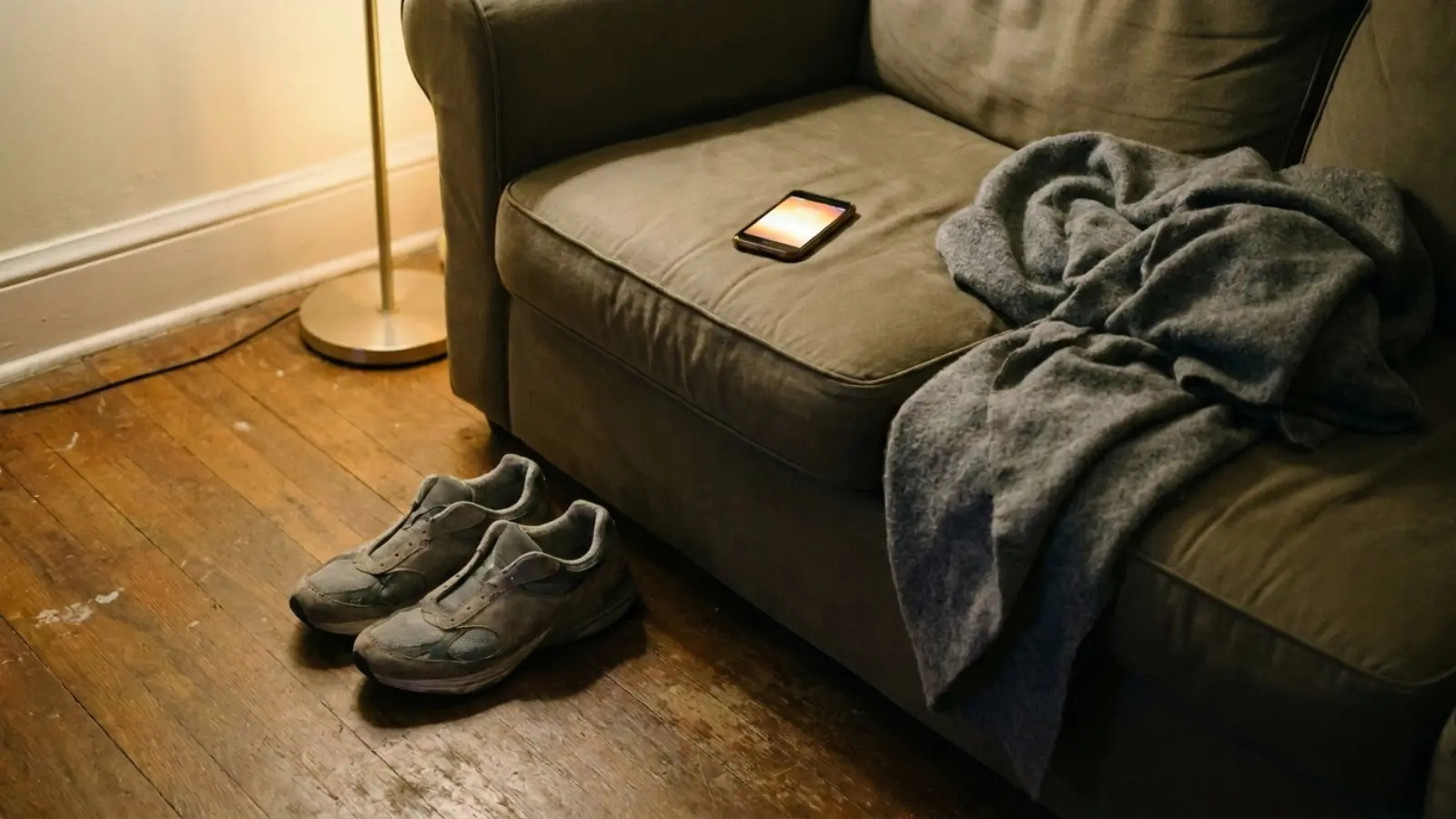
You know what you should do. The run, the dishes, the email. You pick up your phone instead, and an hour later you call yourself lazy.
That word does damage. It turns a choice your brain makes dozens of times a day into a verdict on who you are, and a verdict gives you nothing to work with.
This article swaps it for something you can use. Most of what you call laziness is your brain doing what every brain does: picking the option that costs least right now. Once you see the sum it is doing, you can change the numbers. Make the task cheaper. Make the reward come sooner. Then the easy option and the right one are the same option.
Why am I so lazy?
Because your brain is built to save effort. Daniel Kahneman, who won a Nobel prize for his work on how people make decisions, called it the law of least effort: when there are several ways to reach the same goal, people drift towards the one that asks the least of them.
In Thinking, Fast and Slow he describes two ways of thinking.
System 1 is fast and automatic. It reads a face, finishes “salt and…”, reaches for your phone when you are bored. It costs almost nothing.
System 2 is slow and deliberate. It does sums, follows rules, gets you off the sofa and into the hard thing. It costs effort, and Kahneman gave its chapter a blunt title: “The Lazy Controller”.
Try this before you read on. A bat and a ball cost $1.10 together. The bat costs $1 more than the ball. How much is the ball?
The answer that jumps out is 10 cents. It is wrong: the ball costs 5 cents. Checking takes a few seconds of System 2, and most people do not spend them. More than half the students at Harvard, MIT and Princeton gave the quick wrong answer. At less selective universities, more than 80% did. These are not lazy people. Their brains, like yours, saw no reason to pay for a check.
Lab work points the same way. In 2010, researchers at Princeton let people choose freely between two versions of a task, one of which asked more of their attention. People drifted away from the harder one, and not only to save time or avoid mistakes.
So “why am I so lazy?” has a dull answer. You are not broken. You are running the standard setting.
Two honest notes on the book. Kahneman himself said the two systems are characters in a story, not parts of the brain. And some of it has aged badly: the same chapter leans on a finding called ego depletion, which failed a large replication in 2016. We go through that in books on habit formation. The two systems and the law of least effort are not the parts that failed.
Laziness is a sum, done in the present
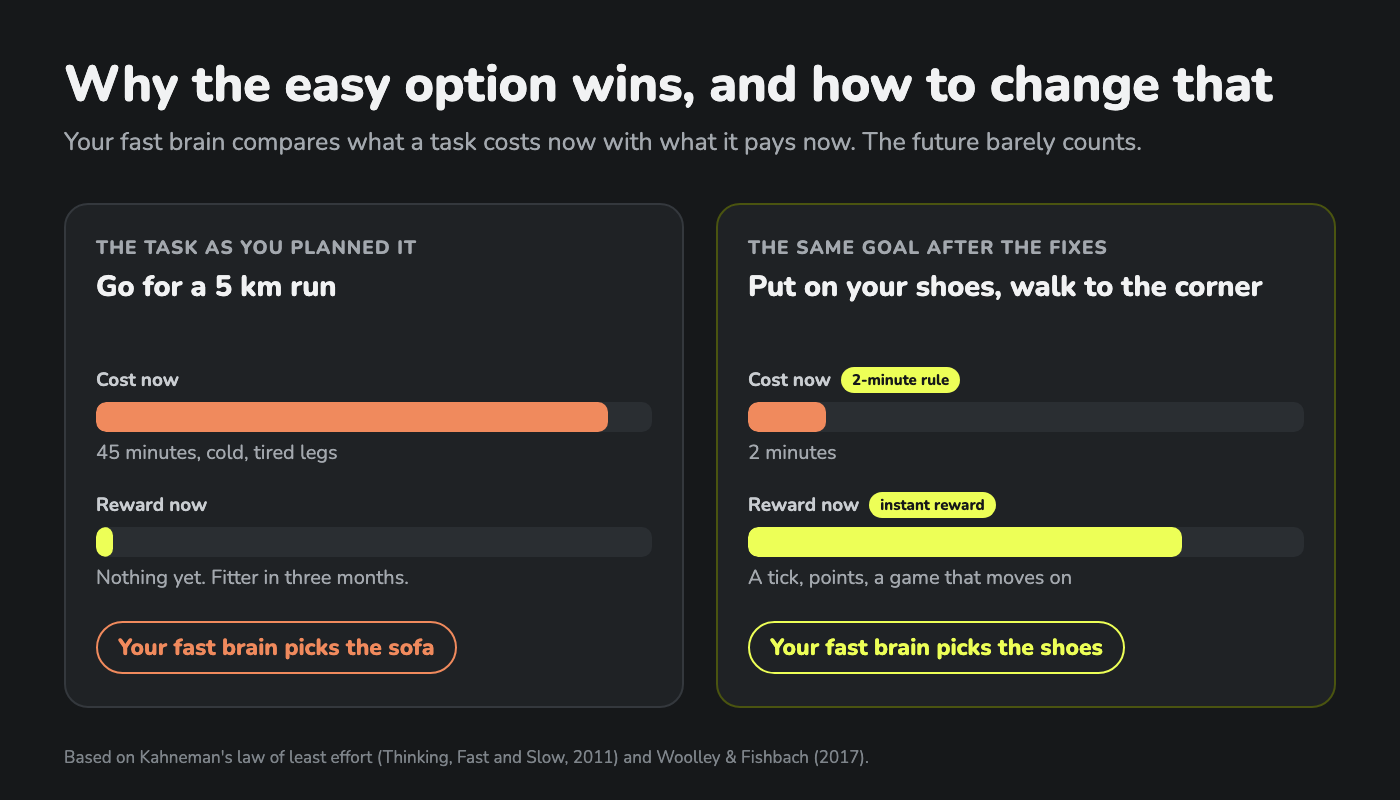
Each time you decide whether to start something, System 1 runs a quick sum. On one side, what the task costs you now: effort, boredom, cold, discomfort. On the other, what it pays you now.
Look at the second side for the things you call yourself lazy about. The run makes you fitter in three months. The tax form saves you a fine in April. The language pays off on a trip next year. Today, they pay nothing. The phone pays at once.
That is the whole problem. In this sum, the future counts for very little.
Kaitlin Woolley and Ayelet Fishbach, at the University of Chicago, asked people about their New Year’s resolutions. Whether they were still sticking to them depended on how much they enjoyed the activity, not on how important they thought the goal was. In another of their studies, with 80 people at a gym, how fun the workout was predicted how long they exercised better than how much they valued its health benefits.
“It matters” is System 2’s argument. System 1 is not listening.
So there are two ways to change the result, and you want both:
- Lower the cost now. That is the 2-minute rule.
- Raise the reward now. That is what a game does.
Fix one: make the task cheap enough to start
The 2-minute rule says: shrink the task until starting it takes two minutes or less. Not “go for a run” but “put on your running shoes”. Not “clean the kitchen” but “clear one counter”. Not “write the report” but “open the file and type the title”.
It works on the sum above. Two minutes is a cost System 1 does not argue with. And nearly all the resistance sits at the start. Once you are in your shoes and out of the door, going on is cheap, and turning back has a cost of its own: you are already dressed.
Three rules make it work:
- The small version must be a real action. “Read one page” is reading. “Think about reading” is not.
- You are allowed to stop at two minutes. If you promise two minutes and then demand an hour, System 1 learns the trick and stops agreeing. Most days you will carry on. Some days you will not, and that has to be fine.
- Let it grow on its own. Two minutes of reading a day turns into ten without you deciding it should.
We go further, with examples for common tasks, in the 2-minute rule.

Fix two: remove the steps in front of the task
The cost is not only the task. It is every step before it: finding your shoes, getting the laptop out of the bag, looking for the form. Each step is one more chance for System 1 to say no.
Wendy Wood, who has studied habits for thirty years, found that about 43% of what people do each day, they do in the same place at the same time, without deciding. The setting decides for them. Use that.
- Put what you want to do in your way. Shoes by the door, book on the pillow, guitar out of its case.
- Put what you want to do less behind extra steps. Phone charging in another room, apps logged out, snacks on a high shelf.
- Do tonight what tomorrow’s tired self will not want to do. Bag packed, clothes out, the first line of the email already typed.
You are not fighting laziness here. You are using it. If the easy path leads to the shoes, a lazy brain takes it.
Fix three: make the reward arrive now
This is the side of the sum most advice ignores. You cannot move the real reward closer: fitness takes months. But you can add a small reward that arrives the moment you finish, so System 1 has something to count.
Games do this well. A game pays you for every small action: a point, a sound, a bar that fills, a new level. None of it matters much on its own. All of it arrives now, and you can see your progress at a glance. People play for hours for rewards worth nothing outside the game, because the payout is immediate.
Does it work for real-life tasks? There is good evidence it can. In a University of Pennsylvania trial published in 2019, 602 adults with overweight or obesity all wore step trackers. Three groups also played a game with points and levels tied to their step goals. All three game groups walked more than the group without a game while it ran. The group whose members competed with each other did best, and was still walking 569 more steps a day than the group without a game twelve weeks after the game had stopped.
Katy Milkman, at Wharton, tested a cheaper version she called temptation bundling. Gym members could listen to gripping audiobooks, such as The Hunger Games, only while they were at the gym. They went to the gym more often. The effect faded after a holiday break, which is worth knowing: a reward that is new wears off, so it has to keep paying.
Two rules for any reward you add:
- Pay for the action, not the result. Reward the walk, not the kilos lost. You control one of them.
- Pay at once. A reward at the end of the month is just another future reward, and System 1 already ignores those.
If you want to turn more of your day into a game, gamify your life shows how, and does gamification help build habits covers what the research says and where it stops.
Fix four: let System 2 decide once
System 2 is slow and costly, so do not ask it to decide every morning. Let it decide once, in advance, and hand the daily part to System 1.
The tool is one sentence: after [something you already do], I will [the two-minute version]. “After I pour my coffee, I put on my shoes.” “After I sit down on the train, I open the language app.” A review of 94 tests with more than 8,000 people found that those who wrote down when and where they would act were clearly more likely to do it. Our guide to building habits covers the rest of the method.
Once the plan is written, there is nothing left to weigh in the morning. The coffee comes, and the shoes follow. That is what consistency looks like from the inside: not more willpower, just fewer decisions. We go further in consistency over motivation.
When it is not laziness
Sometimes the sum is not the problem. If you feel this way about everything, all the time, look at three things first.
- Sleep. A short night makes every task cost more. If you stay up late even when you are tired, read why you stay up when you know better.
- Mood. Losing interest in things you used to enjoy, for weeks on end, is not laziness. It can be depression. Talk to a doctor.
- Attention. If starting has always been much harder for you than for the people around you, in every part of your life, it may be ADHD. The fixes above still help, but some need changing: see building habits with ADHD.
If you mostly put things off rather than avoid them altogether, our free procrastination test gives you a score in under a minute.
A plan for tomorrow morning
- Pick one task you keep avoiding. If you want something new instead, 30-day challenge ideas lists seventy, each sized for a bad day.
- Write its two-minute version.
- Tonight, remove one step in front of it.
- Write the sentence: after [something you already do], I will [the two-minute version].
- Decide what you get the moment you finish: a tick, a point, the next chapter of your audiobook.
- Do it tomorrow. Stop at two minutes if you want to.
If you keep starting and stopping at the same point, why habits are hard to stick to goes through the usual reasons.
Quick answers
What is the cause of laziness? Mostly, the brain’s habit of choosing whatever costs least right now. Kahneman called it the law of least effort. Poor sleep, low mood and ADHD can make it much stronger.
Why do I feel lazy all the time? Look at your sleep first. Then your mood: weeks of losing interest in everything is a reason to see a doctor, not to push harder.
Do I have ADHD or am I just lazy? Only a proper assessment can tell you. One sign worth taking seriously: starting things has always been much harder for you than for others, at school, at work and at home, since you were a child.
How do I stop being lazy and unmotivated? Do not wait to feel motivated. Make the task small enough to start without it, and add a reward that arrives the moment you finish.
What is the law of least effort? Daniel Kahneman’s name for our habit of choosing the least demanding way to reach a goal. He describes it in Thinking, Fast and Slow (2011).
Is laziness a choice? Each time, yes, but the fast, automatic part of your mind makes it, based on cost and reward right now. You change the choice by changing what it weighs, not by blaming yourself.
Can a game really make me less lazy? It can help you start and keep going, if it pays for real actions straight away. In the Pennsylvania trial, people who had competed for points were still walking more twelve weeks after the game ended.
Where KUBBO fits
We built KUBBO around the sum in this article.
Every task you finish pays XP and Gold the moment you tick it, and the Gold builds a medieval city. The health benefit of your walk is still months away. The house it paid for is on your screen now. That is a reward System 1 can count.
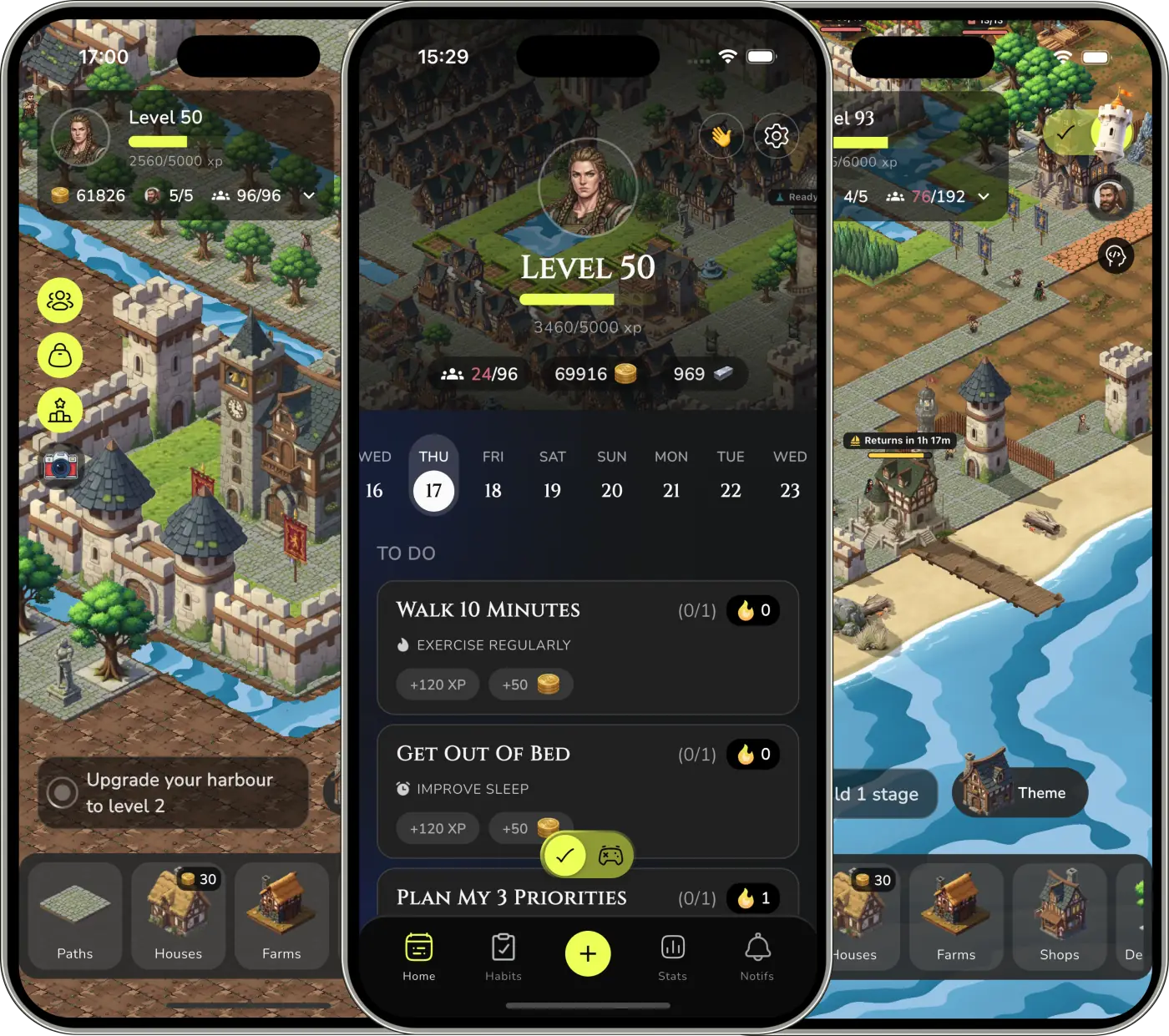
Miss a day and nothing happens. Miss 48 hours and a building gets buried. You dig it out with Gold and carry on. Losing something you can see is a cost System 1 counts too, and it comes in two days, not three months. The research behind the design is in the science.
Pick the task you keep avoiding. Make it two minutes. Pay yourself the moment it is done.