
You used to train. Then came a cold, a busy month, a holiday, and now your kit sits in a corner. Every evening you check whether you feel like going back. You never do.
The problem is the order. You are waiting to want it before you start. With exercise, the wanting tends to turn up after you start.
This article covers why the drive went, a two-week plan to get back into working out that asks very little of you, what to do on days you still cannot face it, and when low motivation is a sign of something a workout will not fix.
Why you have no motivation to work out
Five causes come up most often. Most people have two or three at once.
You judge the workout by its first five minutes. In four studies with 279 adults, researchers at the University of British Columbia asked some people how much they expected to enjoy a workout and others how much they had enjoyed one. People kept expecting less than they got, for yoga, Pilates, aerobics and weights, alone or in a group. The reason: when they pictured a session, they pictured its start, the least pleasant part. So the “no” you feel on the sofa is a forecast, and a poor one.
The break grew without you deciding. Nobody decides to stop for three months. You miss a week with a cold. The next Monday is no longer a normal day but a comeback, and a comeback asks more of you. Each week off raises the price of the first session back: you will be slower and sorer, and you know it. So you put it off, and the price goes up again.
Your plan is all or nothing. “Five times a week, an hour each” leaves no room for a bad Wednesday. When you cannot do the plan, you do nothing. A plan sized for your best week fails in a normal one, which is the first mistake that kills new habits.
The pay-off is months away. Your brain weighs what a session costs now against what it pays now, and fitness pays in spring. We explain that sum in how to stop being lazy. Here it is enough to know that “it is good for me” loses to the sofa most evenings.
Wanting to is not enough. In a review of 10 studies with 3,899 people, 46% of those who meant to be active did not follow through. If you have meant to start again every week since summer, you have plenty of company.
None of these is a flaw in you. Each has a fix, and none of the fixes is “find more motivation”.
Motivation comes after you start
If the forecast is the problem, stop asking for one. “Do I feel like working out?” makes your brain picture the first five minutes, and it will say no. Ask a smaller question: “Can I put my kit on?”
Two findings make this practical.
Put your favorite part first. In the same University of British Columbia paper, people expected to enjoy a workout more when the part they liked best came first rather than last. If you like stretching, start with it. If one song gets you moving, play it in the warm-up, not on the last set.
Build the habit of starting, not the habit of the workout. Psychologists split an exercise habit in two: the urge to begin, and the workout itself once you have begun. In a study of 123 adults, only the first predicted how often people exercised. So the part to make automatic is the first minute: the same cue, the same kit, the same first move. What you do after that can change every week.
The start-small method itself, with examples for other tasks, is in the 2-minute rule. The rest of this article applies it to exercise.
How to start working out again after a long break
Four rules for the first two weeks, then the plan.
1. The first two weeks are for showing up, not for getting fit. You are rebuilding the habit of going, not your old numbers. Judge the two weeks by days done, not by weight lifted or pace.
2. Every session has a full version and a minimum. The minimum is what you can do on your worst day: kit on, one round. It counts as a done day, every time. Most comeback plans leave this out, and it is the part that gets you through week two.
3. Short and often beats long and rare. In a study that followed 111 new gym members for 12 weeks, going at least four times a week for six weeks was the minimum that built the exercise habit. Four 15-minute sessions do more for the habit than one long Saturday.
4. Start below where you stopped. Take your old session and halve it. Keep to an easy pace, where you can talk but not sing. The World Health Organization gives the same advice to anyone starting out: begin with small amounts and build up slowly. It also says that doing some activity is better than doing none.
You have also lost less than you fear. In a small 2018 study, men who had never lifted weights trained for seven weeks, stopped for seven until their leg muscle was back where it began, then trained for seven more. The second time, their leg muscle grew about twice as much: 12.4% against 6.5%. Only seven men finished, so treat it as a hint, not a law. But it points one way: muscle seems to remember earlier training.
Expect to feel sore in the days after your first sessions back. A dull ache that fades is normal. Sharp pain, pain in a joint, or pain that gets worse as you move is not: stop, and read the last section.
Your two-week restart plan
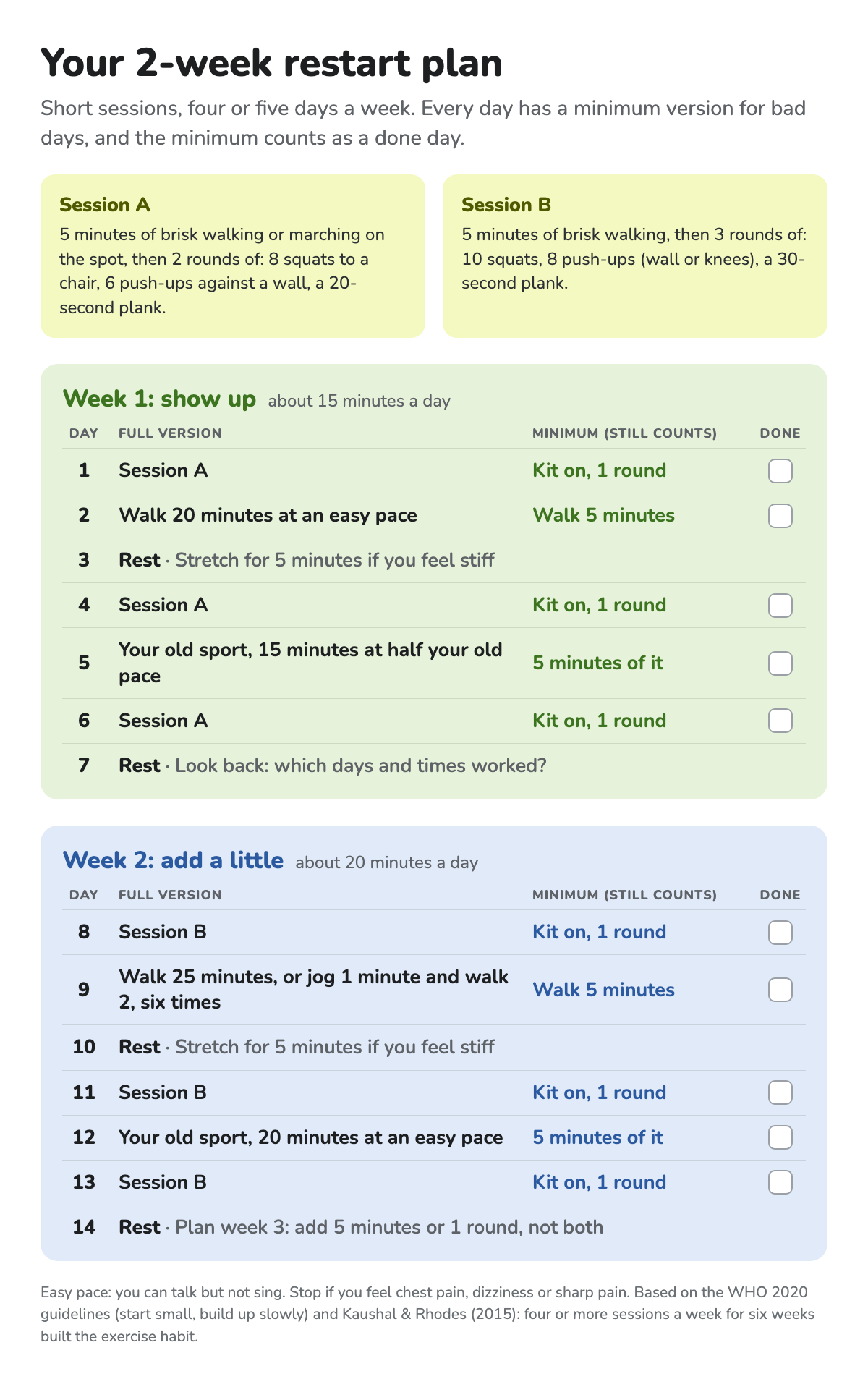
How to use it:
- Pick your days now and write them in. Tie each session to something you already do: after you get home, before dinner, after the kids leave for school.
- Sessions A and B need no gear. A chair and a wall are enough. If you go to a gym, do the same moves there or use machines at the same easy effort.
- “Your old sport” means whatever you used to do: a run, a swim, a class, a bike ride. Go at half your old pace or less. If you never had one, take a walk instead.
- On rest days, stretch if you feel stiff, and nothing more.
- Tick the box for the full version or the minimum. Both count.
- On day 14, plan week 3. Add five minutes or one round, not both.
For longer than two weeks on paper, our free habit tracker template prints a month or more of boxes.
What to do on a no-motivation day
Some days even the plan feels like too much. That is when people skip, and one skip is how the long break starts again.
So do not ask yourself yes or no. Ask how much.
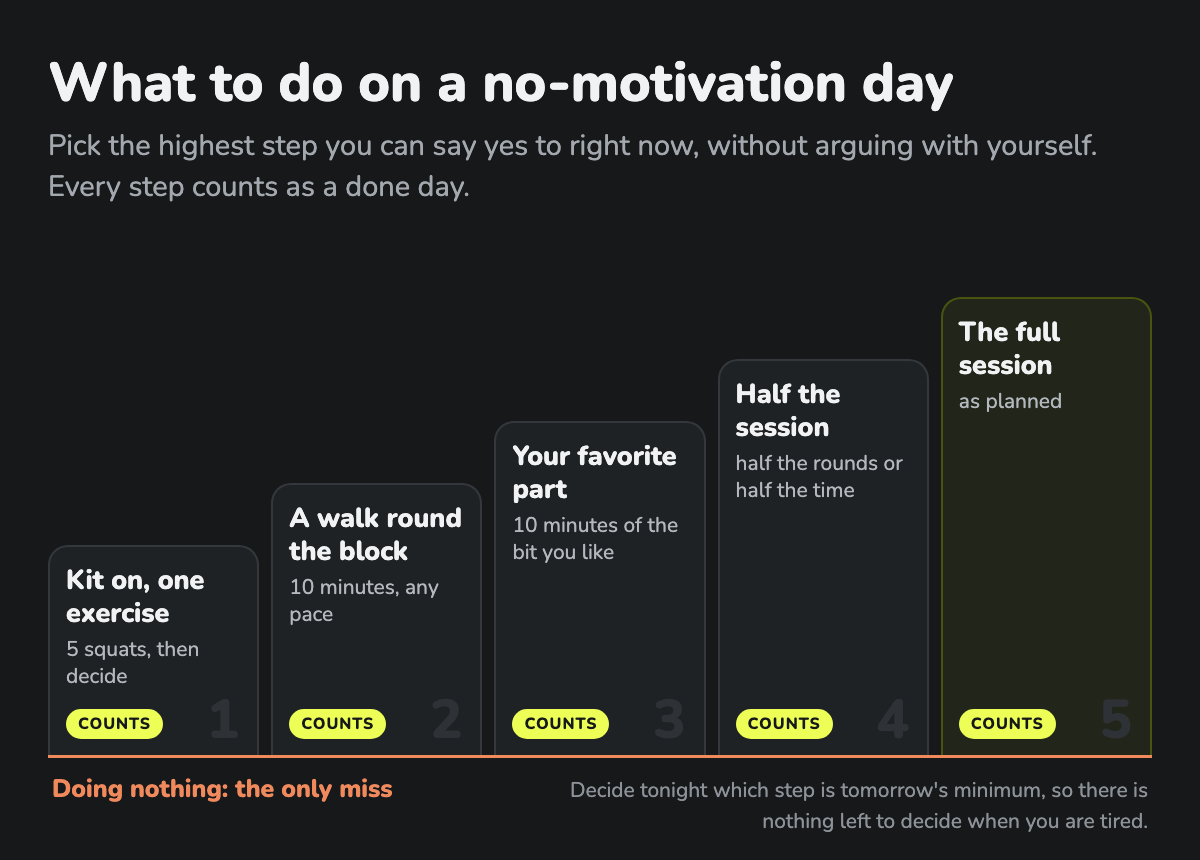
Pick the highest step you can say yes to right now, without arguing with yourself. Then do it. Often you will end up a step or two higher than you planned, because the first minute was the hard part. On the other days, you still kept your word.
Three things make the steps easier:
- Choose tomorrow’s minimum tonight. After a long day, you will not choose well. Write “kit on, five squats” in the plan the evening before, so there is nothing left to decide.
- Change what you dislike, not whether you go. If the gym is the problem, train at home. If running bores you, walk a new route or try a class. Boredom ends many comebacks.
- Keep your kit where you will see it. On the chair, by the door, on top of your bag.
If you have ADHD, boredom may come faster. In a 2025 study of 88 young adults, those with ADHD traits said they got bored far more easily than the others. Plan for it: rotate two or three workouts, change the route or the playlist each week, and count a new class as part of the plan, not a break from it. More in building habits with ADHD.

How to come back after missing workouts
You will miss sessions. Plan for that now, while you are calm.
Do not make them up. Missed Monday and Wednesday? Do not do a double session on Saturday to catch up. That turns the comeback into a punishment, and you will start avoiding it. Do the next planned session as if nothing happened.
Make the first session back the smallest. The day after a miss is the hardest day to go, so make it the cheapest: the minimum, nothing more.
The return is what counts. In 2021, researchers tested 54 four-week programs on 61,293 members of a US gym chain. The best one paid a tiny reward for coming back after a missed workout, about ten cents on top of the usual reward per visit. Not for a perfect week. For the return. What that means for any habit is in consistency over motivation.
A gap is not a reset. In the University College London study behind how long it takes to build a habit, missing one day did not hold back the habit. So one miss is fine. The risk is the second, because two in a row is how a long break starts again. If the gap has already grown past a week or two, go back to day 1 of the plan. Two weeks is not long.
Getting back into working out in January
January is when most people try. In 2018, Strava, the running and cycling app, looked at 31.5 million activities logged in January and found the biggest drop on the second Friday of the month. It called it Quitter’s Day. It has named other days since, all in mid-January.
Many start with a plan built for their best self: five days a week, a new diet and a 6 am alarm, all on January 1. By the second week normal life is back, and the plan does not fit it.
Three ways to do better:
- Start in December. Run the two-week plan before the holidays, when nobody expects anything of you. You reach January 1 on week 3, with the habit already in place. The winter arc rests on the same idea.
- If you start on January 1, start at day 1 of the plan, not at the plan of your best self.
- If you slip, restart on a Monday. Any Monday or the first of a month works, as we explain in New Year’s resolution ideas. You do not need to wait for next January.
When low motivation is a sign of something else
Sometimes the problem is not motivation at all. If one of these fits, deal with it first, and do not push through.
Bad sleep. A short or broken night makes every session cost more. In a small study of 11 women with insomnia on an exercise program, they exercised for less time after nights when they took longer to fall asleep. If you stay up late even when you are tired, read why you stay up when you know better.
Low mood. Losing interest in things you used to enjoy, sport included, is one of the main signs of depression. The NHS says to see a GP if you have felt low for most of the day, every day, for more than two weeks. That is not a fitness problem, and no plan on this page will fix it. If you have thoughts of harming yourself, get help today.
Too much training. If you trained hard for months and now feel flat, tired and slower than before, you may have pushed too far without rest. Loss of motivation is one of the listed signs of overtraining syndrome, and the treatment is rest. See a sports doctor if a week or two off does not help.
Illness. With a cold whose symptoms are all above the neck, such as a runny nose or a mild sore throat, light exercise is usually fine. With a fever, chest congestion, a hacking cough, an upset stomach or aches all over, rest. After a serious illness, an operation or a pregnancy, ask your doctor what is safe and when.
Pain. Pain that is sharp, sits in a joint, or gets worse as you move is a reason to stop and see a doctor or physiotherapist. It is not a test of will.
Before you start. If you have heart disease, kidney disease or a metabolic condition such as diabetes, or you get chest pain, dizziness, fainting or unusual breathlessness, see a doctor before you begin. Under the American College of Sports Medicine’s screening advice, people without any of these can usually start light or moderate exercise without a check-up.
Quick answers
Why do I have no motivation to work out? Usually a mix: a break that grew, a plan too big for normal weeks, and results that take months. Your brain also predicts a workout will feel worse than it does, because it pictures the start. If you have lost interest in other things you enjoy too, see a doctor.
How do I get back into working out after a long break? Start at half of what you used to do. Train short and often, four or five days a week. Give every session a minimum version for bad days, and judge the first two weeks by days done, not by how fit you feel.
How do I start working out again with no motivation? Do not wait for it. Shrink the first step until you can do it without wanting to: kit on, five squats. Motivation tends to turn up once you are moving.
How do I get back into exercise after years off? The same way, only slower: stay on week 1 of the plan for two or three weeks if you need to. If you have a health condition or any of the warning signs above, see a doctor first.
How do I make exercise a habit? Same cue, same days, short sessions, at least four times a week. In one study of new gym members, keeping that up for six weeks was the minimum that built the habit. Make the start automatic. The workout itself can change.
How long does it take to get back into working out? For the habit, plan in weeks, not days: six weeks in the gym study, and about two months on average for daily habits in general. Your fitness may come back faster than you expect.
How do I stay consistent with working out? Plan for missed sessions instead of hoping to avoid them: a minimum version for bad days, no making up sessions, and a small first session after a miss. The rest is in consistency over motivation.
Should I work out if I have no motivation? Usually yes, at the minimum. Not if you are ill below the neck, in pain, or have felt low for more than two weeks. Then rest, or see a doctor.
Where KUBBO fits
The minimum version only works if it counts. On paper, five squats look like a failed day. KUBBO treats them as a done one.
Every habit you tick pays XP and Gold the moment you tick it, and the Gold builds a medieval city. The fitness is months away. The house your squats paid for is on your screen tonight. Name the habit after its minimum, such as “kit on, one round”, and the bad days pay as much as the good ones.
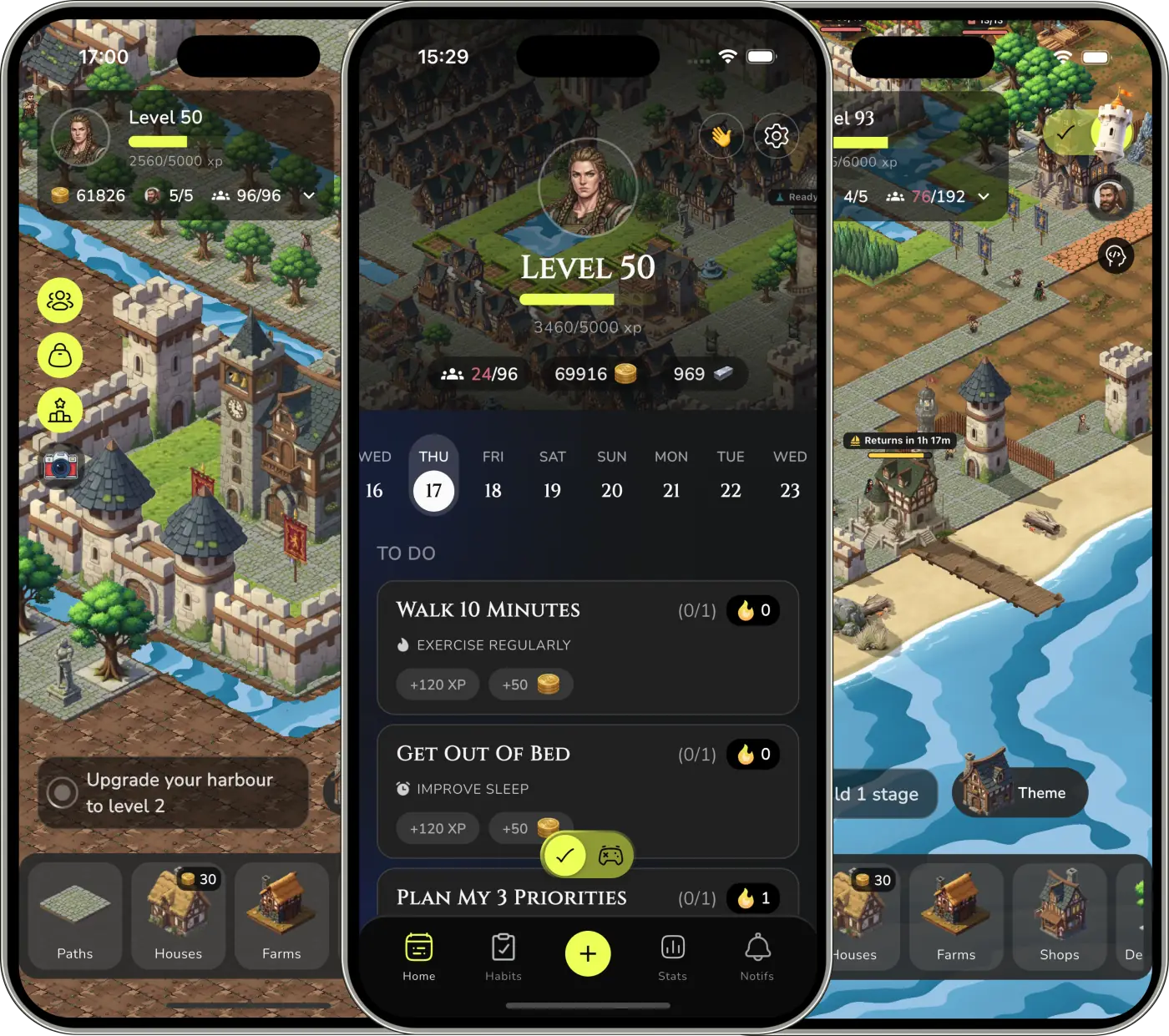
Miss a day and nothing happens. Miss 48 hours and a building gets buried. You dig it out with Gold and carry on. Coming back costs a little, never the whole city. The research behind the design is in the science. For the evidence on points and games, and where it stops, read does gamification help build habits?
Keep reading
- How to stop being lazy, on why the sofa wins and how to change the sum
- Consistency over motivation, on what makes you show up in week six
- The 2-minute rule, for starting anything you keep putting off
- Common mistakes that kill new habits, the six setup errors of week one
- Daily exercise, walking and stretching, our habit guides
- 70 thirty-day challenge ideas, for what to try after week 2
Pick your day 1. Put your kit out tonight. Tomorrow, do the minimum if that is all you have.