
From October 1, a lot of people stop waiting for January. They choose a few rules, such as training four times a week or turning the phone off at 9 pm, and keep them every day until the end of the year. Online, this is called the winter arc.
What is the winter arc?
The word comes from stories. A character’s arc is the change they go through between the first page and the last, from weak to strong or from lost to confident. A winter arc is that change, made in the cold, dark months while nobody is watching, with the result on show in the new year.
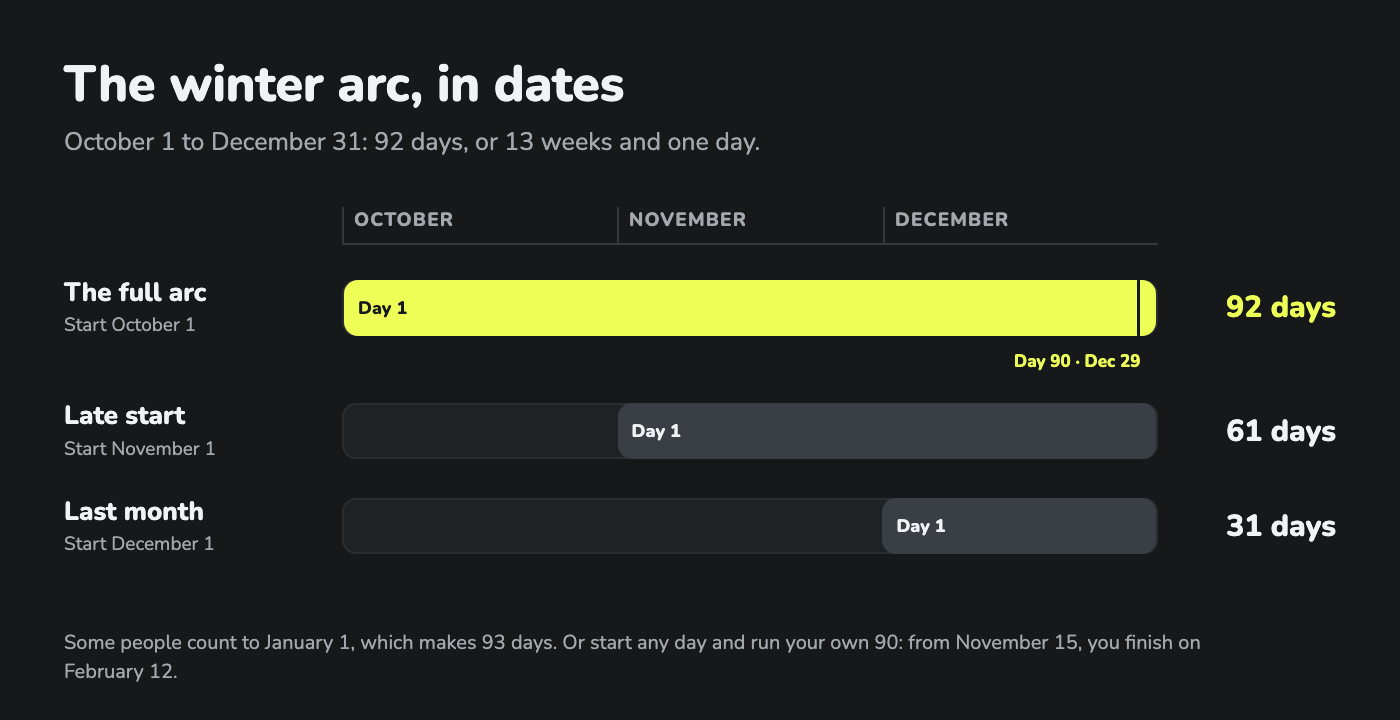
In practice it is a challenge with fixed dates. It starts on October 1 and ends on December 31, the day before New Year’s resolutions begin. The point is to reach January with your habits already running, instead of starting from zero along with everyone else.
There are no official rules. Nobody runs the winter arc and nobody checks. Most people write three to five rules and keep them every day. The common ones come from the gym: train four or five times a week, walk 10,000 steps, eat enough protein, sleep eight hours, drink no alcohol. Others are about the mind: read 10 pages, write in a journal, keep social media short. You will find 36 of them further down.
You can start late. October 1 is not special. It is the first day of a month and of the last three months of the year, and that is enough. Researchers at Wharton found that people take up new goals more often after dates that feel like a fresh start: a Monday, the first of a month, a birthday, the new year. November 1 and December 1 work for the same reason. Start on November 1 and you have 61 days. Start on December 1 and you still have 31.
Where the winter arc comes from
“Winter arc” began as gym slang. According to Know Your Meme, the idea was to bulk up through the winter, then lose the fat before summer, with the arc starting on October 1 each year. The word “arc” most likely comes from manga and anime, where a training arc is the run of episodes in which the hero goes away, trains hard and comes back stronger.
The oldest definition we found is an Urban Dictionary entry posted on August 31, 2022: “A time where every man must face the mental and physical challenges of winter. A time to put your head down and get things done.” That October, posts on Twitter (now X) about entering a winter arc collected thousands of likes, and a TikTok posted in December 2022 by @nickpedersen__ passed 3 million plays.
It grew every year after that. In September 2023, a YouTube Short about the winter arc by Improving Afro passed 11 million views. In autumn 2024 it became a mass trend. TikTokers filmed themselves shaving their heads before October 1, and one of those videos passed 25 million plays in five days. The top comments joked that the winter arc is “not a double XP event”. Brands and dictionaries followed. Gymshark explained the trend in October 2024, Urban Dictionary made it word of the day on October 17, 2024, and Merriam-Webster now lists it as slang.
Since then it has spread well beyond the gym. There are soft winter arcs built on sleep, walks and less time on the phone, winter arcs for students, and winter arcs about money. Some people now start on September 1 and call the four months the Great Lock In.

Ideas for your winter arc
Choose three to five rules. A good mix is one for your body, one for your sleep or your mind, and one that matters only to you. Every rule must pass one test: at the end of the day, can you answer yes or no? “Eat better” fails. “Cook dinner at home five nights a week” passes.
Where a rule has a link, the guide behind it explains how to start it and keep it.
Body
- Train three or four times a week. Choose the days on Sunday and put them in your calendar. → daily exercise
- Walk 8,000 steps a day. → daily walking
- Stretch for 10 minutes before bed. → daily stretching
- Do 20 minutes of yoga in the morning. → yoga
Sleep
- Get up at the same time every day, weekends too. → wake up early
- Lights out by 11 pm. → consistent sleep schedule
- Charge your phone outside the bedroom. If your evenings vanish into it, read why you stay up when you know better.
- No coffee after 2 pm.
Food
- Drink a glass of water before your first coffee. → drink more water
- Cook dinner at home five nights a week. → meal prep
- No added sugar on weekdays. → no added sugar
- Eat vegetables at lunch and dinner.
Mind
- Meditate for 10 minutes. → meditation
- Write three lines in a journal. → journaling
- Write down three things that went well today. → gratitude practice
- Spend 20 minutes outside in daylight. In December it gets dark early, so take your lunch break outside.
Focus and phone
- Keep social media under 30 minutes a day. Set the limit in your phone’s settings. → digital detox
- No phone for the first 30 minutes after you wake up.
- Do 90 minutes of focused work before lunch. → deep work
- Phone off at 9 pm.
Learning
- Read 10 pages a day. Over 92 days that is about 900 pages, or three average books. → daily reading
- Practice a language for 15 minutes. → learn a language
- Write 300 words. → creative writing
- Take one online lesson a week in a skill you want for next year.
Money
- Write down every purchase the same day. → budget tracking
- Spend nothing on weekdays except bills and food.
- Move a fixed sum to savings every Monday.
- Cancel one subscription a month. That is three by December 31.
Home
- Tidy for 10 minutes before bed. → daily declutter
- Make your bed every morning.
- Clear one drawer or shelf a week.
- Lay out tomorrow’s clothes and bag at night. → morning routine
People
- Message one friend a week you have not spoken to in a while.
- Call your family every Sunday.
- Eat one meal a week with someone, phones away.
- Thank one person a day for something specific.
Three ready-made arcs
The classic arc: train four times a week, walk 8,000 steps, eat protein at every meal, lights out by 11 pm, no alcohol.
The soft arc: 20 minutes outside, water before coffee, phone out of the bedroom, three good things a day, one call a week. It is for people who want to feel better by January rather than look different. If that is you, our 30-day self-care challenge is a good way to find out which of these help you most.
The student arc: same wake-up time every day, 90 minutes of focused work before lunch, read 10 pages, social media under 30 minutes, train three times a week.
How to write rules you will keep
Three to five, no more. Every extra rule is one more way to fail a day. Keep the other ideas for a spring arc.
Give each rule a small version for bad days. “Train” can shrink to ten push-ups, “read 10 pages” to one page. The small version counts as a full day. This is the 2-minute rule, and it is what gets you through week six.
Never miss twice. Missing one day is normal. Two in a row is where most challenges end, as we explain in common mistakes that kill new habits.
Write them down before day 1, and do not add more halfway. A rule added in November because you feel strong is the first to go in December.
Not sure which part of your life needs the arc? The wheel of life has you score eight areas of your life, pick one to three, and suggests small habits for them. The goal-setting worksheet turns one goal into daily habits. To track it all on paper, set our free habit tracker template to “3 months”, starting in October, and add the 90-day challenge and the rewards at 30, 60 and 90 days.

Why turn your winter arc into a game?
The winter arc already looks like a game. It has a season with a start and an end, a score you check every day, and people talk about leveling up. The “double XP event” joke works because everyone can see it. The question is whether it is a good game.
Most are not. The reward for each rule is weeks away. In week three you do not see more muscle, a calmer mind or a bigger savings account. You see a grid with a lot of empty boxes left. That is where most arcs stop.
Enjoyment keeps you going, not importance. Kaitlin Woolley and Ayelet Fishbach, at the University of Chicago, asked people about their New Year’s resolutions. Whether they were still keeping them depended on how much they enjoyed the activity, not on how important they thought the goal was. A game is a way to make a dull rule more enjoyable today.
Games can change what people do. In a University of Pennsylvania trial published in 2019, 602 adults wore step trackers, and three groups also played a game with points and levels tied to their step goals. All three game groups walked more than the group without a game while it ran. The group that competed did best, and was still walking 569 more steps a day than the group without a game twelve weeks after the game had stopped. A 2014 review of 24 studies on games in apps and services found mostly good effects on motivation and behavior, with the size depending on the design.
A good game for a winter arc does four things:
- It pays at once. Points the moment you tick a rule, not in January.
- It shows progress you can see. A number that grows, or a picture that fills in.
- It forgives a bad day. A streak that drops from 40 to zero after one miss makes many people quit. A small cost and a way back keeps you playing.
- It has an end. The arc has one built in. At 92 days it is also longer than the 66 days a daily habit took to feel automatic for the typical person in a University College London study, though it took anywhere from 18 to 254 days depending on the person and the habit. The numbers are in how long it takes to build a habit.
One warning: do not put points on what you already love. In a classic study from 1973, children who were promised a prize for drawing later chose to draw less than children who were not. Use the game for the rules you would skip, not for the ones you look forward to. More on this in does gamification help build habits?
Where KUBBO fits
We built KUBBO to be that game. Put your winter arc rules in it as habits. Every one you tick pays XP and Gold the moment you tap it, and the Gold builds a medieval city. By December 31, your arc is a city you can see.
Miss a day and nothing happens. Miss 48 hours and a building gets buried. You dig it out with Gold and carry on, and the rest of your city is still standing.
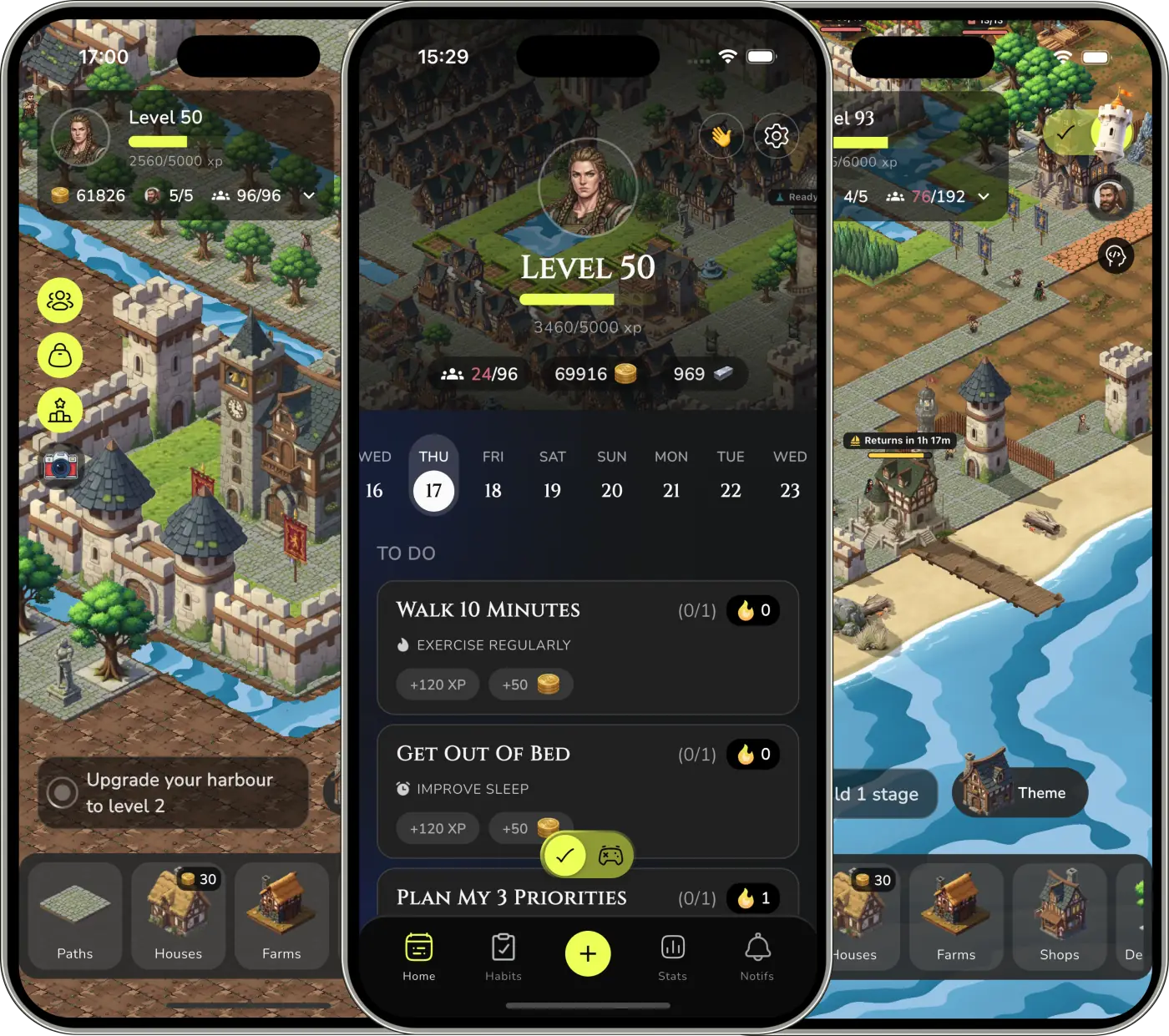
The research behind that design is in the science, and gamify your life shows how the rest of the app works.
Quick answers
When does the winter arc start and end? It starts on October 1 and ends on December 31. Some people count to January 1, and some stop after 90 days, on December 29.
How long is the winter arc? 92 days, which is 13 weeks and one day.
Can I start my winter arc in November or December? Yes. Start on the first of the month, or on a Monday. From November 1 you have 61 days, and from December 1 you have 31. You can also run 90 days from your own day 1 and finish in the new year.
Is the winter arc good or bad? It depends on your rules. Small rules you can keep on a bad day make it a good way to reach January with habits in place. Rules like waking at 4 am, cold showers and no friends until January are hard to keep for 92 days, and dropping them can leave you feeling worse than before you started. If a rule leaves you tired or alone, swap it.
Are there different rules for men and women? No. Lists of winter arc rules for girls tend to be softer, with more sleep, walks and self-care. Pick the rules that fit your life, whoever you are.
What comes after the winter arc? In January, keep the rules that worked and drop the rest. To add one new habit, run a 30-day challenge. Some people go on to a spring arc or a summer arc.
Do I need an app? No. A paper tracker on the fridge works, and our habit tracker template prints one for three months. An app helps if a grid of boxes has never kept you going before.
Keep reading
- 70 thirty-day challenge ideas, to pick one rule and test it for a month
- The 30-day self-care challenge, for a soft arc
- How to stop being lazy, for the days the arc feels heavy
- Consistency over motivation, on what makes you show up in week six
- How to build habits, the full guide
- Books on habit formation, for the long winter evenings
Write your rules tonight. Then do day 1 tomorrow, even the small version.