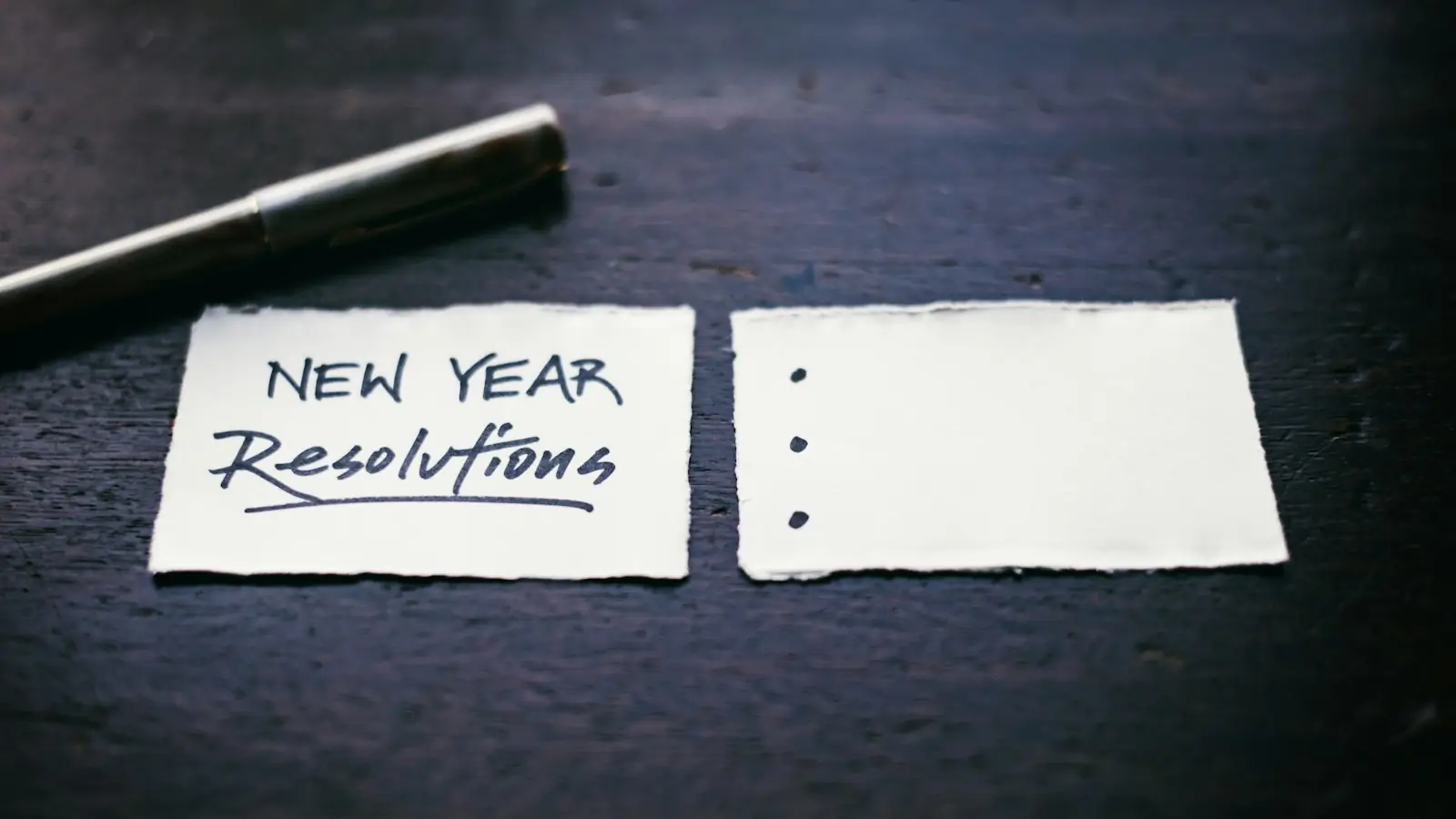
Here are 60 New Year’s resolution ideas for 2027, in eleven groups. Each one is an action you can tick off every day or every week, not a wish.
Most resolutions do not fail because they were bad ideas. They fail because they were too big, too vague, or no fun by the third week of January. So before the list, three questions to help you choose. After it, what research says about keeping a resolution past February.
How to choose your resolutions
Read the list with three questions in mind.
Can you answer yes or no at the end of the day? “Get fit” fails this test. “Walk 20 minutes after lunch” passes. If you cannot tell whether you did it today, you cannot keep it for a year.
Is it something to do, or something to stop? Researchers at Stockholm University followed more than 1,000 people for a year after New Year. Those whose resolution was about doing something kept it more often than those whose resolution was about avoiding something. “Drink sparkling water with dinner” works better than “stop drinking wine”.
Will you enjoy it, or only be glad you did it? Kaitlin Woolley and Ayelet Fishbach, at the University of Chicago, asked people about their New Year’s resolutions and checked back weeks later. Those who enjoyed the activity itself were more likely to still be at it. The benefits they expected in the long run made no difference. If you hate running, a running resolution will be hard to keep. Pick the sport you like.
Not sure which part of your life needs a change? The wheel of life has you score eight areas of your life and suggests small habits for the weakest ones.
60 New Year’s resolution ideas for 2027
Where an idea has a link, the guide behind it explains how to start it and keep it.
Health and fitness
- Get back into exercise, two minutes at a time. After a long break, the hard part is not the workout. It is the start. So make the start tiny: put on your running shoes and step outside. For the first week, that is the whole resolution. Most days you will keep going once you are out, and on the days you do not, you still kept your word. This is the 2-minute rule. → daily exercise

- Drink less alcohol, starting with a month without. Dry January is the easy way in. It has a clear end date, and many people do it with you. A University of Sussex team followed people through Dry January and asked them again six months later. They drank on fewer days, drank less on those days, and got drunk less often, whether or not they had finished the month. In their 2019 survey, about 7 in 10 said they slept better, and more than 8 in 10 saved money. January not a good month for you? Pick another one. At parties, keep a drink you like in your hand that has no alcohol in it.
- Eat less sugar, and use honey where you still want some. Start with the sugar you add yourself: in coffee, tea, yogurt and porridge. Honey has more taste than white sugar, so a smaller spoon is often enough. But be honest about one thing: honey is still sugar. A spoonful of honey even has more calories than a spoonful of sugar, because it is denser. The World Health Organization puts honey in the same group as table sugar, and advises keeping all of it under 10% of your daily calories. The gain comes only from using less. → no added sugar

- Walk 8,000 steps a day. Most phones count steps without an app. → daily walking
- Drink a glass of water before your first coffee. Leave the glass by the kettle at night. → drink more water
- Go to bed at the same time every night, weekends too. Set an alarm for bedtime, not only for the morning. → consistent sleep schedule
- Stretch for 10 minutes before bed. → daily stretching
- Do 20 minutes of yoga three mornings a week. A free video on YouTube is enough to start. → yoga
- Run your first 5K. Beginner plans take about nine weeks, with three runs a week, and start with one minute of running at a time.
- Quit smoking or vaping. Choose a date and tell the people around you. Ask a doctor or pharmacist about nicotine patches or gum, which raise your chances. Most countries have a free quit line.
Food and cooking
- Learn to cook, one new recipe a week. By December you will have tried about fifty dishes and kept a dozen you can make without the book. Start with the meal you buy most often. People who cook dinner at home most nights eat fewer calories and less sugar than people who rarely cook, according to a study of more than 9,000 American adults. → meal prep

- Cook dinner at home five nights a week. It saves money too.
- Eat 30 different plants a week. Fruit, vegetables, beans, nuts, seeds, grains, herbs and spices all count. In the American Gut Project, people who ate more than 30 kinds of plants a week had a more varied set of gut bacteria than people who ate fewer than 10. It was a small comparison, so take it as a nudge, not proof.
- Prepare your lunches on Sunday. → meal prep
- Learn to bake bread. One loaf a week. By March you will not need the recipe.
Mind and mental health
- Try meditation, 10 minutes a day. In a 2019 study at New York University, people who had never meditated did a 13-minute guided meditation every day. After eight weeks, their mood, attention and memory had improved, and they felt less anxious. After four weeks, the change was not yet clear. So give it two months before you judge it. A free app is enough, or count ten breaths and start again. Small version: three slow breaths. → meditation
- Write three lines in a journal before bed. → journaling
- Write down three good things from your day. → gratitude practice
- Spend 20 minutes outside in daylight every day. In winter, that means at lunchtime.
- Talk to a therapist. If cost is the problem, ask your doctor what is free where you live.
- Keep one evening a week just for you. No chores, no catching up on work. Our 30-day self-care challenge has ideas for how to spend it.
Phone and social media
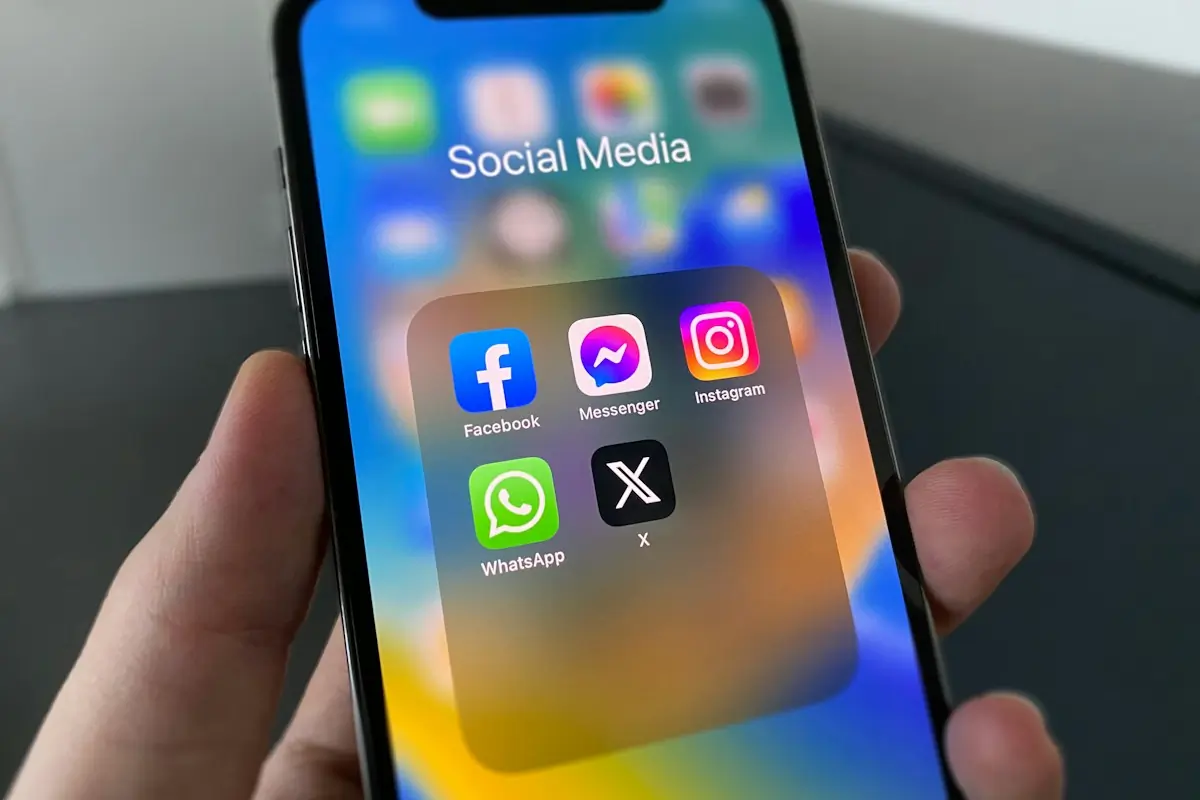
- Watch your time on social media, or delete the apps. Start by looking. Screen Time on an iPhone, or Digital Wellbeing on Android, shows how many hours each app took last week. Then set a daily limit for each app. If the limits do not hold, delete the apps from your phone and use them on a computer only. In a study at Stanford and New York University, more than 1,600 people were paid to switch off Facebook for four weeks. They gained about an hour a day. They felt a little happier, and they used Facebook less after the study ended. → digital detox
- Charge your phone outside the bedroom. If your evenings vanish into it, read why you stay up when you know better.
- No phone for the first 30 minutes of the day.
- Turn off every notification except calls and messages from people.
- Unfollow every account that leaves you feeling worse.
Reading and learning
- Read 15 minutes a day. Adults read about 240 words a minute. At that pace, 15 minutes a day comes to about 1.3 million words in a year, or more than a dozen novels. Leave the book where your phone usually sits, on your pillow or the arm of the sofa. Small version: one page. → daily reading

- Learn a language, 15 minutes a day. → learn a language
- Finish one online course. One, not five. Put the lessons in your calendar like a class.
- Take a first aid course. It takes a day, and you may use it for the rest of your life.
- Write 300 words a day. A diary, a blog, the start of a book. → creative writing
If you want books to start with, here are the best books on habit formation.
Music, art and dance
- Learn music: start with rhythm and reading notes. You do not need an instrument for the first weeks. A free app or video course teaches you to read a score and clap a rhythm in 10 minutes a day. Piano or guitar comes much easier after that.
- Learn the piano. A second-hand keyboard is enough to start. Play 15 minutes every day: it does more than two hours on Sunday. Small version: play one scale.
- Learn the guitar. Learn four chords first: G, C, D and E minor. Many songs use nothing else. Your fingertips will hurt for the first two or three weeks, until the skin gets harder. Small version: tune it and play one chord.

- Learn to draw. Draw one thing on your desk every day for 10 minutes, in the same notebook, and date each page. In March, compare it with page one.
- Learn to dance. Book a beginners’ class in salsa, swing, hip-hop or whatever is taught near you. You can go alone: in most partner classes, partners change every few minutes.
- Sing in a choir. Many amateur choirs take anyone who comes.
- Take one photo a day for a year. By December, you have a record of the whole year.
New things to try
- Try a new activity every month. Climbing, pottery, padel, chess, improv. Book one trial session in January. If you like it, go back. If not, try another in February. That makes twelve tries in 2027.
- Learn to swim. Many pools run lessons for adults.
- Visit one place near you that you have never been to, every month.
- Take a trip on your own.
- Volunteer once a month.
- Grow something you can eat. Herbs on a windowsill are enough.
Work, business and side projects
- Start a YouTube channel and post one video a week. Your first ten videos are practice, so plan for them to be bad. Choose a subject you could talk about for fifty videos. Film with your phone, edit in a free app, and post on the same day each week. Small version on a bad week: film one minute.
- Buy a course to start your business, and finish it. A course is worth its price only if you finish it and act on it. Before you pay, write down what you will sell and to whom. Then give 30 minutes a day to the course or the business, and aim for your first paying customer before the summer. Walk away from any course that promises easy money.
- Do 90 minutes of focused work before lunch. → deep work
- Write down tomorrow’s three priorities before you stop work.
- Leave work on time three days a week.
Money
- Write down every purchase the same day. → budget tracking
- Move a fixed sum to savings on payday, automatically. Aim for one month of expenses first.
- Cancel every subscription you have not used in a month.
- Wait 48 hours before you buy anything you do not need.
Home
- Tidy for 10 minutes before bed. → daily declutter
- Make your bed every morning. → morning routine
- Clear one drawer or one shelf a week.
People
- Call your family every Sunday.
- Message one friend a week you have not spoken to in a while.
- Eat one meal a week with someone, phones away.
- Say yes to one invitation a month that you would usually turn down.
How to keep your New Year’s resolutions
Making a resolution is worth it. In a study by John Norcross at the University of Scranton, 46% of people who made a New Year’s resolution were still keeping it six months later. Among people who wanted to change but made no resolution, only 4% were.
Here is what makes the difference.
Write it as something to do. In the Stockholm study, 59% of people with “do” resolutions said they had kept them after a year, against 47% of people with “stop” resolutions. “Stop eating sweets” leaves a gap. “Eat fruit after dinner” fills it.

Make it daily, and small enough for a bad day. A resolution you do every day becomes automatic sooner than one you do once a week. Give each one a small version, such as one page, one push-up or one chord, and count it as a full day. In a University College London study, a daily habit took 66 days on average to feel automatic, and anything from 18 to 254 days depending on the person. The numbers are in how long it takes to build a habit.
Pick one to three. Each extra resolution is one more way to fail a day. Start with one in January, and add the next once the first runs without effort.
Never miss twice. Missing one day is normal. Two in a row is where most resolutions end, as we explain in common mistakes that kill new habits.
Write it down and track it. The goal-setting worksheet turns one goal into the daily habits behind it. Our free habit tracker template prints a month or a year of boxes to tick.
Start again on any Monday. Katherine Milkman and her colleagues at Wharton found that people take up new goals more often after dates that feel like a fresh start: the new year, but also a Monday, the first of a month or a birthday. If your resolution breaks in February, you do not need to wait for 2028. The next Monday will do.
Why turn your resolutions into a game?
The reward for most resolutions comes months later. In the third week of January, you do not see a fitter body, a calmer mind or a bigger savings account. You see a habit tracker full of empty boxes. That is when most people stop.
A game pays you now. Points the moment you tick a habit, progress you can see grow, and a way back after a bad day. In a University of Pennsylvania study, adults who played a game with points and levels tied to their daily step goals walked more than those without a game, and the group that competed was still walking more twelve weeks after the game had ended. Remember Woolley and Fishbach: enjoyment is what keeps people going, and a game is a way to make a dull habit more enjoyable today. More in does gamification help build habits?
Where KUBBO fits
We built KUBBO to be that game. Put your resolutions in it as daily habits. Each one you tick pays XP and Gold the moment you tap it, and the Gold builds a medieval city. By December 2027, your year is a city you can see.
Miss a day and nothing happens. Miss 48 hours and a building gets buried. You dig it out with Gold and carry on, and the rest of your city still stands.
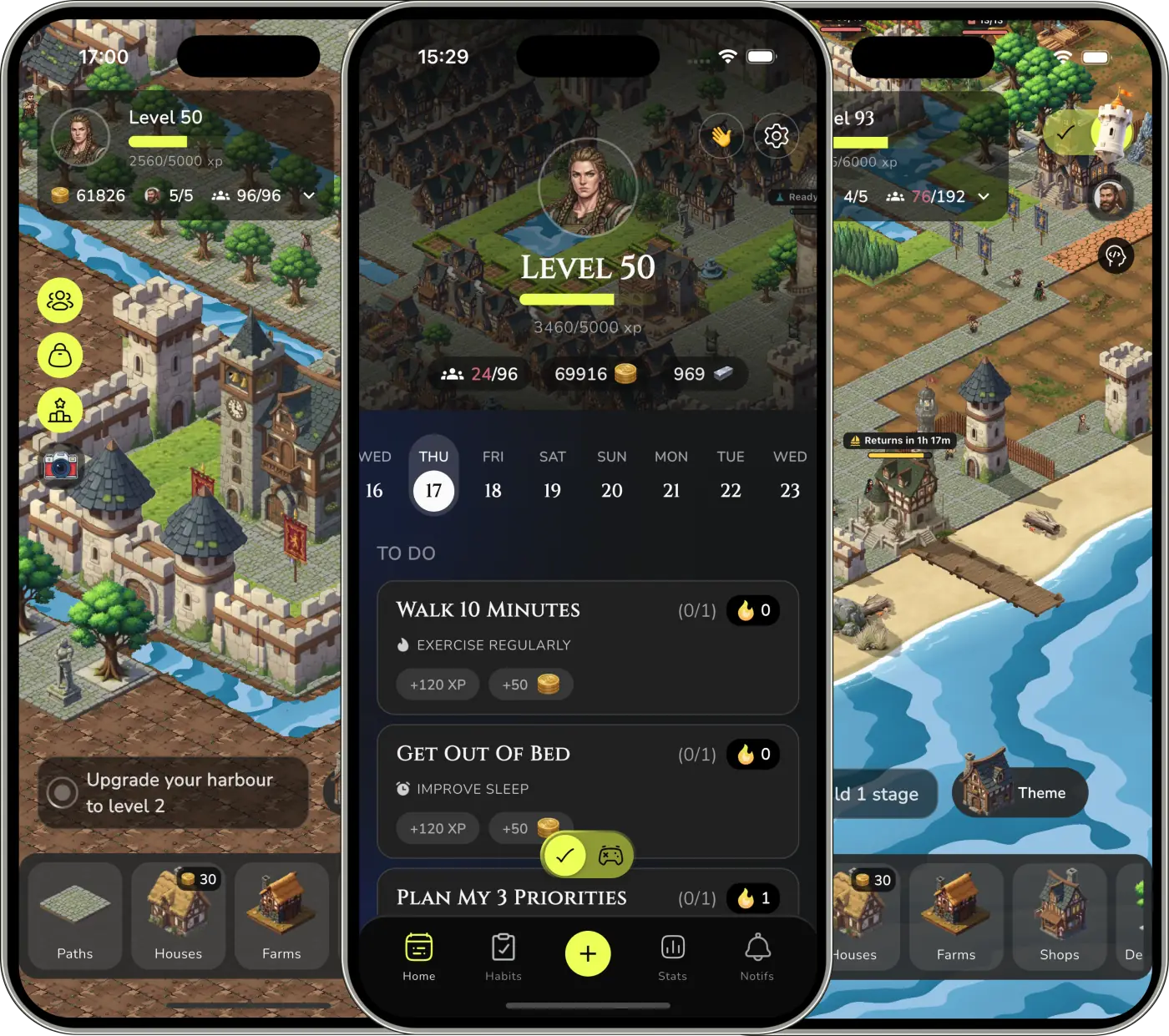
The research behind that design is in the science, and gamify your life shows how the rest of the app works.
Quick answers
What is a good New Year’s resolution? One you can do every day or every week, that you can answer yes or no to, and that you enjoy. “Read 15 minutes before bed” is a good resolution. “Read more” is a wish.
How many New Year’s resolutions should I make? One to three. With more, one busy week in January is enough to drop them all.
What are the most common New Year’s resolutions? In a YouGov poll of American adults in December 2025, the top plans for 2026 were to exercise more, be happier, eat healthier, save money and improve their health. In the list above, they are numbers 1 to 21 and 50 to 53.
When do most people give up? In the first weeks. Strava, the running app, looked at 31.5 million activities logged in January 2018 and saw the biggest drop on the second Friday of the month. It called it Quitter’s Day. That is why the small version matters: it gets you through the tired evenings, and they come early.
Is it too late to make a resolution in February? No. Start on the next Monday or the first of next month. Those dates work for the same reason January 1 does.
Should I start before January 1? You can. The winter arc is a challenge that runs from October 1 to December 31, so you reach the new year with your habits already running. If you want to test one idea first, run a 30-day challenge.
Keep reading
- 70 thirty-day challenge ideas, to test one resolution for a month
- What is the winter arc?, to start before January
- How to stop being lazy, for the days the resolution feels heavy
- Consistency over motivation, on what keeps you going in week six
- Why is it hard to stick to habits?
- How to build habits, the full guide
Pick one idea tonight and write its small version next to it. On January 1, do the small version.