
The email to your landlord has sat in your drafts since March. Every morning you mean to send it, and every evening it is still there. If you have looked up how to stop procrastinating with ADHD, you have seen the advice: break it down, set a timer, reward yourself.
The advice is not wrong. It lacks two things: an order to try it in, and any sign of what works. Most ADHD procrastination tips online cite little or no research.
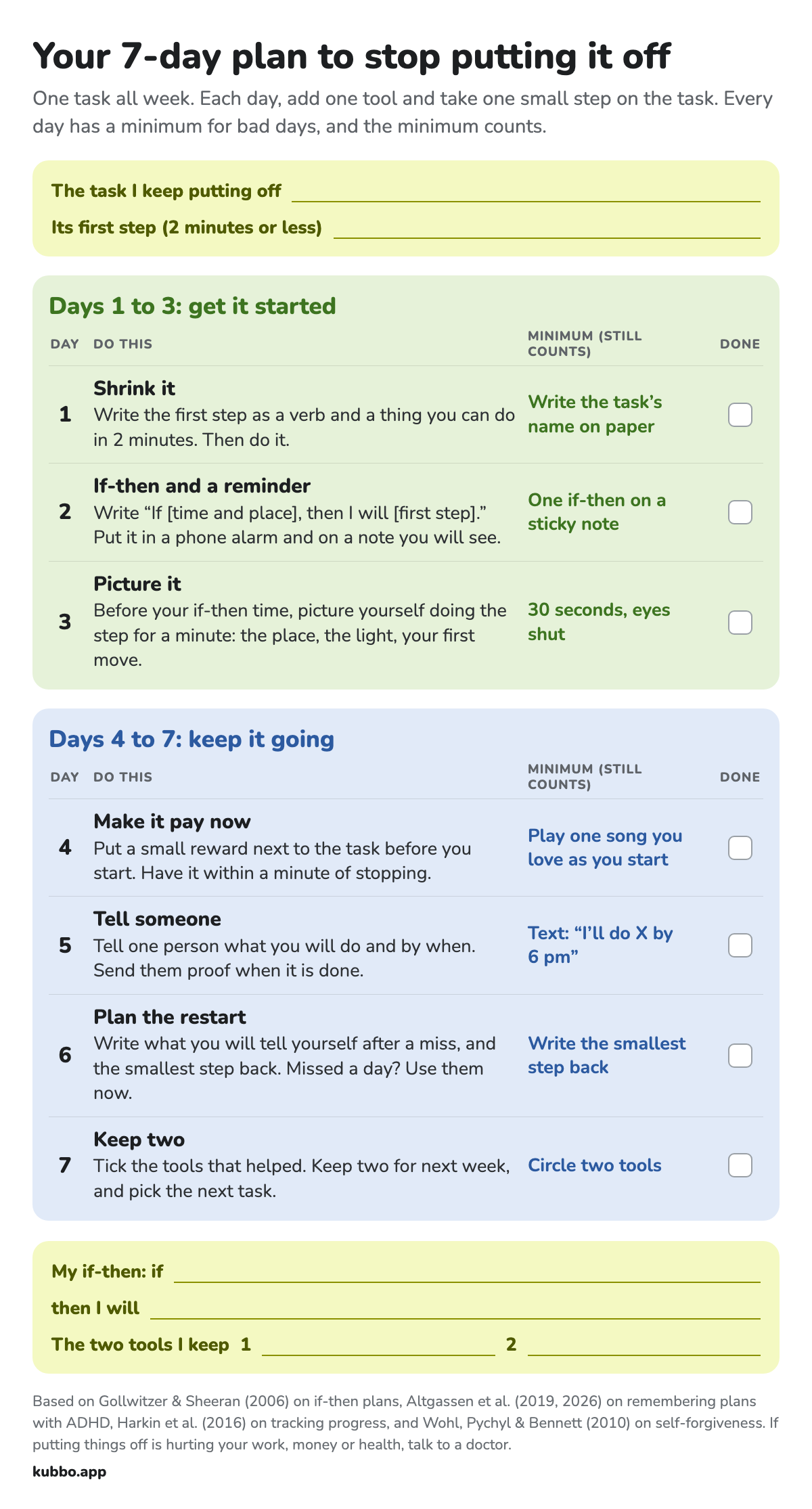
This article gives you both. It sums up what studies say lies behind the delay, then turns the best-tested methods into a seven-day plan: one small tool a day, each with a minimum for bad days. There is a printable version below.
Why you put things off when you have ADHD
Everyone procrastinates. Piers Steel pooled 691 findings on it, and among the strongest links were tasks you find unpleasant, pay-offs that are far away, doubt that you can do it, and acting on impulse (Steel, 2007). With ADHD, several of these are stronger.
Inattention matters more than impulsiveness. In a study of 54 students with more or fewer ADHD traits, only inattention went with putting things off in general, not impulsiveness (Niermann & Scheres, 2014).
You forget what you meant to do. Researchers asked 29 adults with ADHD and 24 without to carry out plans in their own lives. The ADHD group remembered and carried out fewer of them, and this forgetting partly explained why they procrastinated more (Altgassen et al., 2019). Some of what looks like avoidance is a plan that did not come back to mind at the right time.
Later counts for little, and so does the task. In a 2026 survey of 640 adults, inattention was linked to procrastination through two main routes: a stronger pull toward what pays now, and a sense that the task is worth little (Netzer Turgeman & Pollak, 2026). A study of 114 students pointed to two more: managing time, and getting organized (Bolden & Fillauer, 2020).
Putting it off feels better, for now. Fuschia Sirois and Timothy Pychyl describe procrastination as a way to feel better now, at a cost your future self pays (Sirois & Pychyl, 2013). The task makes you feel bad, so you do something else, and for an hour you feel better.
None of this is a flaw in your character. Each cause has a fix, and the plan below has one for each. Not sure how much you put things off? Our 60-second procrastination test will tell you.
What therapy teaches about procrastination
The best evidence comes from therapy. A 2018 review pooled 12 trials, with 718 people, that tested talking therapies for procrastination. On the whole they helped a little. Three trials of cognitive behavioral therapy (CBT), a short, practical therapy that works on habits and thoughts, showed a moderate benefit (Rozental et al., 2018).
For adults with ADHD, the best-known trial comes from Steven Safren and his team in Boston. They gave 86 adults, all on ADHD medication but still struggling, 12 sessions of either CBT or relaxation training. After CBT, 67% counted as improved on an ADHD symptom scale, against 33% after relaxation, and those who improved kept their gains a year later (Safren et al., 2010). The program taught planning with a calendar and a task list, breaking big tasks into steps, and handling distraction. It also offered a session on procrastination, and 40 of the 43 people in the CBT group chose to take it.
The plan below is not therapy. It gathers tools you can try alone, from these programs and from the studies above: small first steps, plans tied to a time and place, reminders you can see, rewards that come soon, and a way back after a slip.
How to stop procrastinating with ADHD: a 7-day plan
Three rules for the week:
- One task. Pick the one you have avoided longest, or the one that costs you most. If you finish it midweek, take the next and carry on.
- One tool a day, plus one small step on the task. Keep any earlier tool that helped.
- Every day has a minimum. On a bad day, do the minimum. It counts as a done day.
Day 1: pick one task and shrink the first step
Write the task at the top of the plan. Then write its first step: a verb and a thing, small enough to do in two minutes. Not “do my taxes” but “open the tax website and find my login”. Do that step today.
You can stop there. The point of day 1 is a first step so small that dreading it feels silly. How to shrink a task, and where the method stops working, is in the 2-minute rule.
Minimum: write the task’s name on paper.
Day 2: write an if-then plan and a reminder you can see
An if-then plan ties the step to a moment: “If it is 9 am and I have poured my coffee, then I will open the tax website.” Peter Gollwitzer and Paschal Sheeran pooled 94 tests of such plans and found a medium to large effect on reaching goals (Gollwitzer & Sheeran, 2006). You decide when and where in advance, so the moment itself prompts you.
With ADHD, add one more piece. Forgetting the plan is part of the problem, so do not rely on memory to bring it back. Put the if-then in a phone alarm, with the words as its label, and on a sticky note where the task happens: the laptop lid, the front door, the bathroom mirror. Our goal-setting worksheet has a box for it.
Minimum: one if-then on a sticky note.
Day 3: picture yourself doing it
Before your if-then moment, spend a minute picturing yourself doing the step. Not the result, the act: where you sit, what you see, the first thing your hands do.
Researchers call this episodic future thinking. In a 2026 study, 63 adults with ADHD and 64 without kept a diary of everyday plans. Those who pictured themselves doing each plan as they made it carried out more of them (Altgassen et al., 2026). It is one study, and the effect was no longer clear once the authors allowed for people’s skill with words, so treat it as promising, not proven. It costs a minute.
Minimum: 30 seconds, eyes shut.

Day 4: make it pay now
The 640-adult survey found two routes: rewards that come later count for less, and the task seems worth little. Its authors suggest short deadlines and rewards that come soon (Netzer Turgeman & Pollak, 2026).
So give the task a pay-off today. Set a small reward next to it before you start, and have it within a minute of stopping: the good coffee, one loud song, a square of chocolate. Or keep a podcast for this task alone. How to size rewards, turn them into points and change them before they bore you is in our guide to an ADHD reward system. Why the easy option wins in the first place is in how to stop being lazy.
Minimum: play one song you love as you start.
Day 5: tell someone what you will do and by when
A deadline only you know about is easy to move. So tell someone: “I’ll send the form by 6 pm. I’ll text you when it’s done.” Then send the proof.
A review of 138 studies with nearly 20,000 people found that tracking your progress helps you reach goals, and helps more when you report it to others or write it down (Harkin et al., 2016).
You may have heard of body doubling: working while someone else is there, in the room or on a video call. Many people with ADHD say it helps. The research is thin: one survey of 220 people describes how they use it, but no trial has tested it (Eagle et al., 2024). It costs nothing to try.
Minimum: one text: “I’ll do X by 6 pm.”
Day 6: plan the restart
You will miss a day. Plan what happens next while you are calm.
In a 2010 study, first-year students who forgave themselves for putting off studying for their first midterms procrastinated less before the next round. They also had fewer bad feelings between the two (Wohl, Pychyl & Bennett, 2010). The authors’ reading: forgiving yourself lets you stop dwelling on the slip and turn to the next task.
Write two lines today. First, what you will tell yourself after a miss, in the words you would use with a friend: “I put it off. Most people do. Back to it.” Second, the smallest step back, smaller than day 1’s. If you missed a day this week, use both now.
Do not catch up. The day after a miss, do the minimum, not twice the work. Consistency over motivation explains why the return matters more than the streak.
Minimum: write the smallest step back.
Day 7: keep the two tools that worked
Look back at the week. Which tools did you use, and on which days did you take a step? Tick the tools that helped and keep two for next week. Drop the rest without guilt. Then pick the next task, or stay with this one if it is not done.
Writing it down is part of the method: in the review of 138 studies, progress that people recorded helped more than progress kept in their heads. For more than a week, our free habit tracker template prints a month of boxes.
Minimum: circle two tools on the plan.
When it is more than procrastination
Putting things off is human. It may point to something more if:
- it has cost you a job, money, a friendship or your health, or keeps coming close;
- you have struggled to focus, get organized and finish things since childhood, at home and at work;
- you feel low most of the day, most days, or have lost interest in things you used to enjoy.
If you think you might have ADHD, the NHS advises seeing a GP when symptoms affect your studies, work or relationships. Outside the UK, start with your own doctor. If you already have a diagnosis and still struggle, ask about CBT. The NHS lists talking therapies such as CBT for adults with ADHD, and in the Safren trial CBT helped people for whom medication alone was not enough.
Low mood needs its own care. The NHS says to see a GP if you have felt low most of the day, every day, for more than two weeks. If you have thoughts of harming yourself, get help today.
And if what you put off is going to bed, read why you stay up when you know better.
Quick answers
How do I stop procrastinating with ADHD? Pick one task and shrink its first step. Tie it to a time and place with an if-then plan, and put the reminder where you will see it. Add a quick reward and someone to report to. When you slip, restart small. The 7-day plan above adds these one day at a time.
How do I get things done with ADHD? One task at a time, a first step you can do in two minutes, reminders you can see, and rewards that come soon. A plan on paper or in your phone beats a plan held in your head.
Why do I procrastinate even when it feels bad? Because avoiding the task feels better right now. Researchers describe procrastination as a way to fix your mood now: you escape the task’s bad feeling, and your future self pays. A smaller first step makes the bad feeling smaller too.
Is procrastination a sign of ADHD? Not on its own. Everyone puts things off, and procrastination is not on the official list of ADHD symptoms. But people with more inattention tend to procrastinate more. If you have struggled to focus and finish things since childhood, talk to a doctor.
Is procrastination an addiction? No. The manuals doctors use do not list it as one. It works more like a habit: delay brings quick relief, so you delay again.
What is the 10-3 rule for ADHD? A tip shared online: work for 10 minutes, rest for 3, repeat. We found no study that tests it. Short blocks can make starting easier, which is the idea behind day 1.
How do I deal with crippling procrastination? Start smaller than feels reasonable, and do not wait to feel ready. If it is costing you work, money or health, or you feel low most days, see a doctor. It may be more than procrastination, and CBT helps.
Does ADHD medication help with procrastination? Medication treats ADHD symptoms such as inattention, which go with putting things off. But in the Safren trial, adults on medication still had symptoms, and CBT on top of it helped. Ask your doctor what fits you.
Where KUBBO fits
KUBBO is a habit and self-care app. It takes care of two parts of the plan: the reminder of day 2 and the quick pay-off of day 4.
Every task you tick pays XP and Gold at once, and the Gold builds a medieval city. That is the pay-off now, for tasks whose real reward is weeks away. Each habit or task can carry up to three reminders, so your if-then rings on your phone and you do not have to remember it. Habits repeat on the days you pick. For a one-off job like the landlord email, add a one-time task and give it a day, so a reminder can ring.
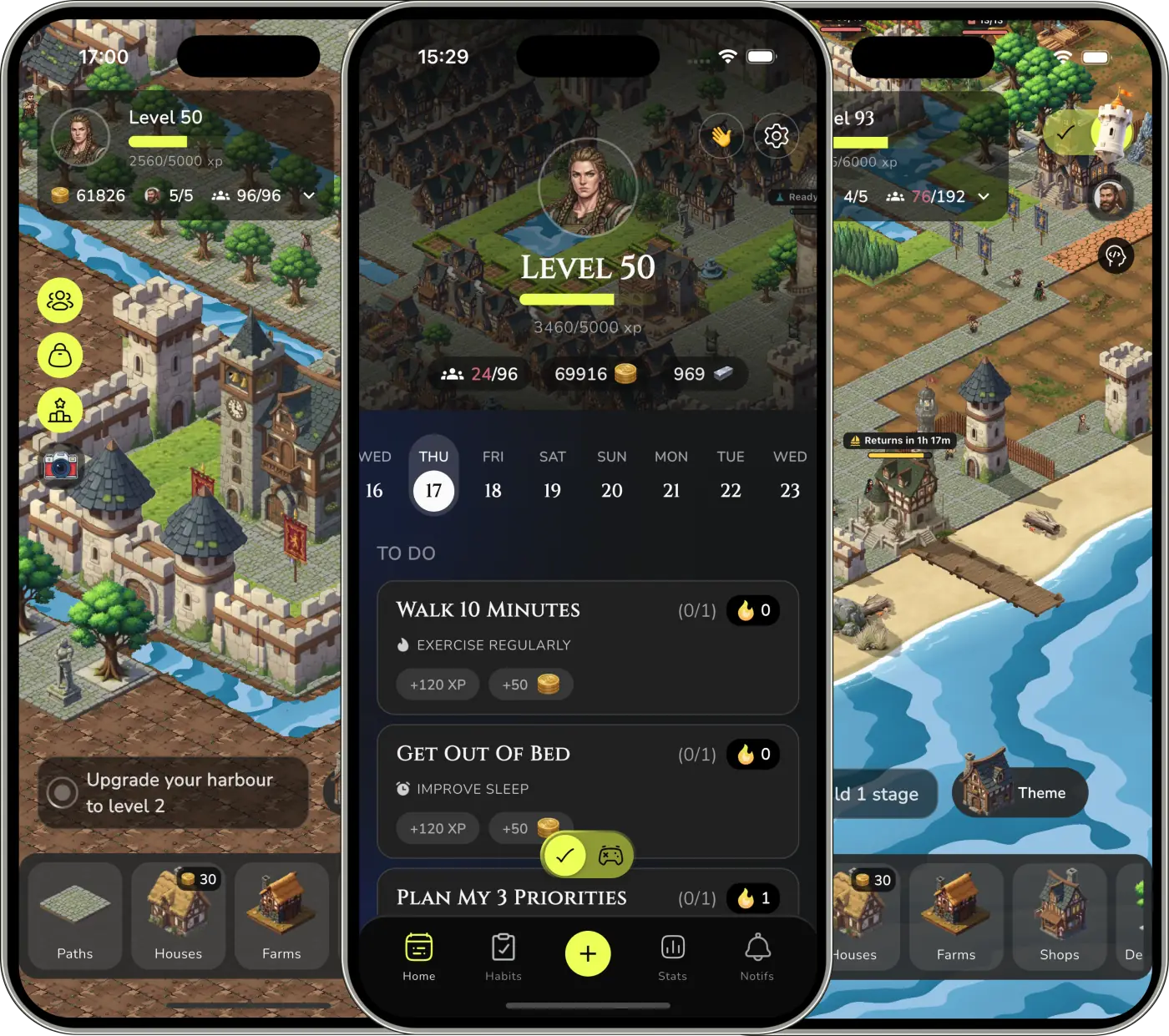
Miss 48 hours and a building gets buried. You dig it out with Gold and carry on. That is day 6 as a game: coming back costs a little, never the whole city. To see how this differs from a plain checklist, read what an ADHD habit tracker does, or the research behind the app in the science.
Keep reading
- The 2-minute rule, for shrinking any task you avoid
- ADHD reward system for adults, with a printable reward menu
- How to stop being lazy, on why the easy option wins
- Cleaning with ADHD and the ADHD morning routine, two places the delay shows up every day
- No motivation to work out?, a two-week restart plan for exercise
- How to build habits with ADHD and the best habit trackers for ADHD
Write your task on the plan tonight. Tomorrow, do the first step, or the minimum.